The weaver from Ranti who built an export house on a flood plain.
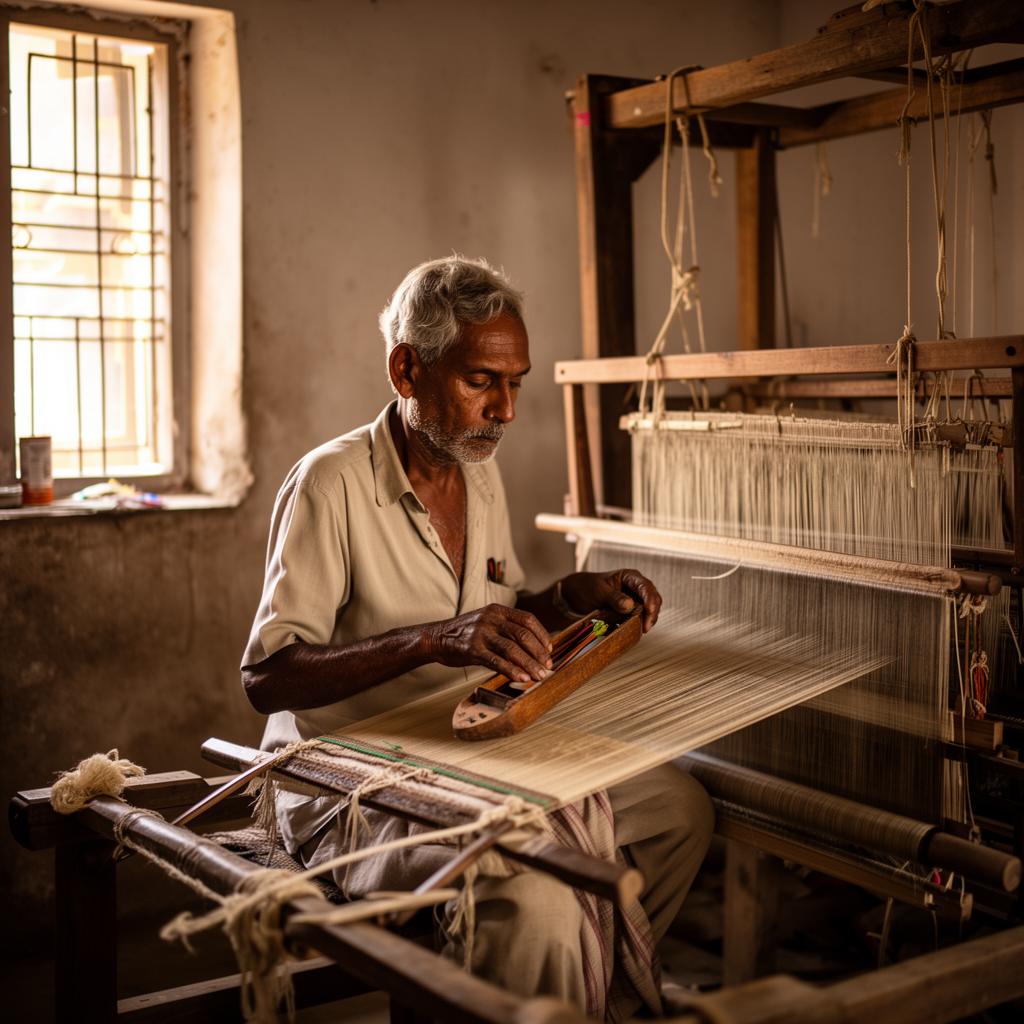
Ramashankar Paswan is 54. His grandfather wove cotton gamchhas for the local haat. His father sold to a trader in Jhanjharpur for whatever was offered. He ships Madhubani-motif stoles to a boutique in Kiyosumi, Tokyo, and three stockists in Brooklyn. The road between those three generations runs through two devastating floods, one bank loan that nearly broke him, and twenty-six years of refusing to leave.
1. The geography that decides everything.
To understand why Ranti is both improbable and inevitable as the origin of an export business, you have to begin with the rivers. Madhubani district sits in the northern Mithila plain, bordered by Nepal on the north and the Kosi-Kamala-Bagmati system on the south and east. The soil is alluvial and generous; the floods are annual and indiscriminate. The 2008 Kosi breach — when the river abandoned its embankment near Kusaha and cut a new channel through Supaul, Madhepura, Araria and parts of Madhubani — displaced an estimated 3.3 million people and submerged roughly 3.7 lakh hectares of cropland. Ramashankar lost his grandfather's loom, two trunks of finished cotton, and the only photograph of his mother.
He returned eleven days later, after the water dropped to knee height. "We did not have insurance," he said, the first time we met in the courtyard of his expanded workshop. "We did not have the idea of insurance." This is not a sentimental detail. It is the central operating constraint of every enterprise in north Bihar: weather risk is uncovered, infrastructure is intermittent, and capital formation happens in spite of, not because of, the surrounding system.
Madhubani is also one of India's lowest-ranked districts on the NITI Aayog Composite Human Development metrics, with a literacy rate of 58.6% (2011 Census) and per-capita NSDP among the lowest quartile in the country. The nearest functioning textile testing laboratory — required for any serious export certification — is in Varanasi, 380 km away. Until 2019, the nearest container freight station was Kolkata, 620 km by road, much of it single-lane.
2. A craft that was never just craft.
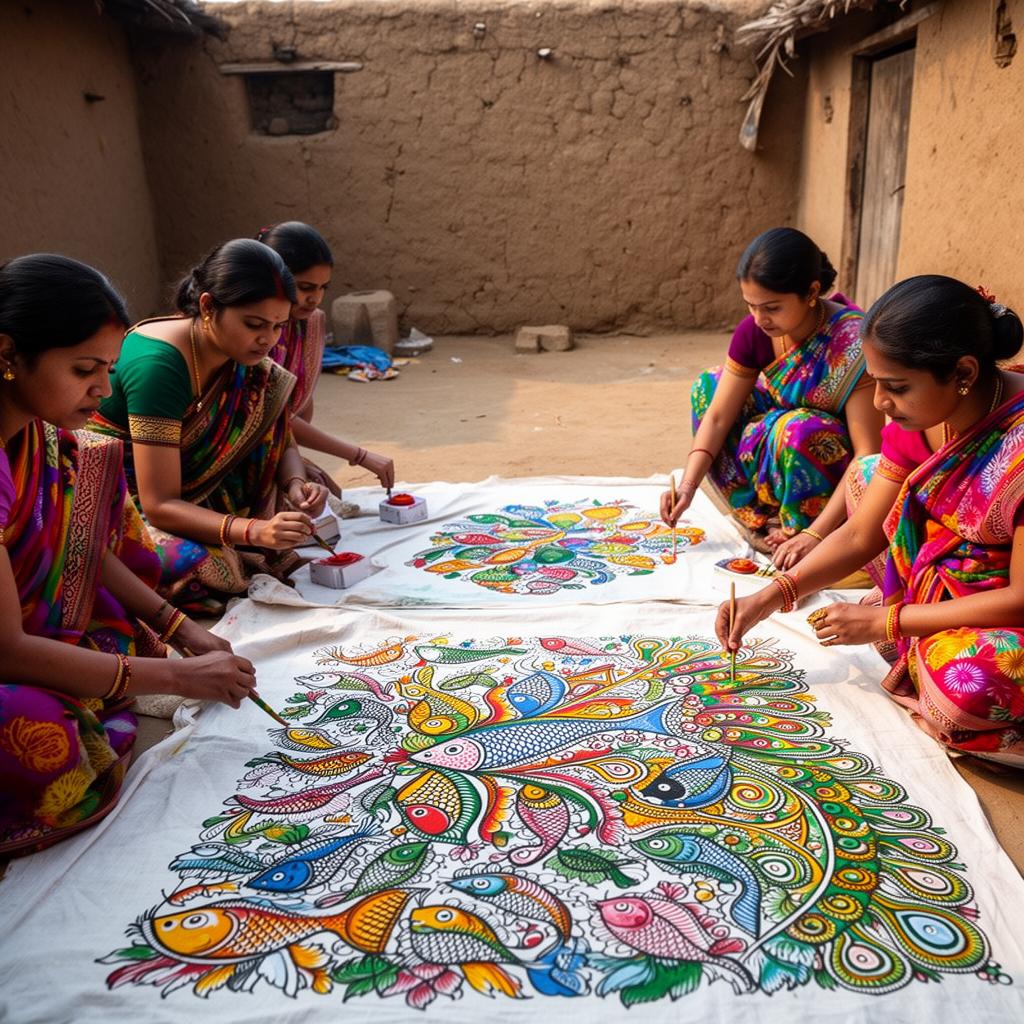
Mithila painting — the practice the world later branded as "Madhubani art" — was, for most of its documented history, a domestic ritual, not a commercial product. Women painted the kohbar ghar (the bridal chamber) for weddings, the aripan on courtyard floors for festivals, and the deities for Chhath. The first commercial intervention came after the 1934 Nepal-Bihar earthquake, when the British colonial administrator W. G. Archer, walking through the rubble, photographed the wall paintings still standing in ruined homes and later wrote about them for Marg in 1949. The second came in 1966, when, in response to a severe drought, the All India Handicrafts Board encouraged Mithila women to transfer their wall art onto handmade paper for sale.
That intervention created the careers of Sita Devi, Jagdamba Devi, Ganga Devi, Bauwa Devi — names that later went to Padma awards and to galleries in Tokyo, Paris and Geneva. But it also created a structural problem that the cluster has never fully solved: the art moved from wall to paper, then paper to cloth, and at each step the value capture moved further from Madhubani itself. By the late 1990s, a sari that retailed for ₹14,000 in a Khan Market boutique was paying the painter in Ranti ₹800.
Ramashankar is not a painter. He is a weaver — the substrate, in the cluster's quiet hierarchy, that the painters need. His father's loom produced the plain-weave cotton on which other households painted. This division of labour, which lines up uncomfortably with caste lines in the region, is the second thing he set out to change.
"Everyone wanted to buy the painting. Nobody wanted to ask who wove the cloth underneath. I decided I would put my name on the selvedge. In small letters. But there."
3. The first loan, and the lesson.
In 2001, Ramashankar applied for a working-capital loan of ₹45,000 from a public-sector bank branch in Madhubani town. The file took fourteen months and seven trips. The branch manager, he recalls without bitterness, "was not a bad man — he simply had no template for a weaver who wanted to buy yarn in advance of a confirmed order." The loan eventually came through under a now-defunct artisan-credit scheme, at 12.5% interest, against the collateral of his wife's gold bangles. He used it to buy 40 kg of mill-spun cotton from Bhagalpur and to commission two extra pit looms.
The 2004 Kosi flood — smaller than 2008, but still severe — destroyed all three looms and most of the yarn. He defaulted. The bank moved to attach the bangles. His wife, Sunaina Devi, who today runs the finishing unit, refused to surrender them and instead persuaded a women's self-help group attached to the local Jeevika cluster to refinance the bank at 9%. The Jeevika network — formally the Bihar Rural Livelihoods Promotion Society, launched in 2007 with World Bank support — would by 2019 cover roughly 1.3 crore rural women in the state. In 2004, in Ranti, it was eleven women and one register book.
The lesson he took from that episode was not about banks. It was about books. From 2005 onwards, every metre of cloth that left his shed has been entered in a hardbound ledger, with the dyer's name, the painter's name (if applicable), the buyer, the price, and the date of payment. When the first export enquiry arrived eleven years later, that ledger was the document that made him bankable.
4. The middleman problem.
Between 2005 and 2014, Ramashankar sold almost entirely through three intermediaries — a wholesaler in Janakpur (across the open Nepal border, 38 km away), a state emporium agent in Patna, and a Delhi-based exporter who would visit twice a year, pick up stock on consignment, and pay in tranches that often arrived nine to eleven months later. The Delhi exporter, he later learned, was selling his stoles to a Japanese department-store buyer at roughly 6.4x the price he was paying Ranti.
This is not unusual. A 2017 study by the Indian Institute of Foreign Trade on north Indian craft clusters found that primary producers in Madhubani, Bhagalpur and Mubarakpur captured between 11% and 18% of final retail value, against 34–42% for comparable artisan clusters in Kutch and 51% for the Channapatna toy cluster in Karnataka. The difference is not skill. It is the distance — physical, linguistic, and informational — between the producer and the end market.
Two things changed that distance for Ramashankar. The first was the GI tag granted to Madhubani paintings in 2007 and the parallel GI for Bhagalpuri silk in 2013, which together gave buyers a legal vocabulary for authenticity. The second, more decisively, was a 3G signal. By 2014, Airtel and BSNL had reasonable coverage in Ranti. His older son, then in Class 11, opened a Facebook page in November that year and photographed each stole as it came off the loom.
5. Tokyo, by accident.
In March 2016, a Japanese textile researcher named Tomoko Saito — who had been visiting Mithila since the early 2000s as a doctoral student under the late Tokio Hasegawa, the Tokyo-based curator credited with introducing Mithila art to Japan in 1980 — walked into Ramashankar's shed with a translator. She was looking for a specific quality of plain-weave cotton, GSM 110, untreated, to back a series of paintings being prepared for an exhibition at the Mithila Museum in Tokamachi, Niigata. (The Mithila Museum, founded by Hasegawa in 1982, holds the world's largest collection of Mithila art outside India — roughly 15,000 works.)
Ramashankar quoted her ₹190 per metre. She asked for 600 metres. He took the order on the condition that 30% be paid in advance — the first time in his working life he had asked that of a buyer. She agreed without negotiation. The cloth shipped, against a NEFT advance and a balance against a copy of the air waybill, in August. He bought his first smartphone with the margin. The second order, in early 2017, was for 1,800 metres and arrived with an introduction to a buyer at a small womenswear label in Kiyosumi.
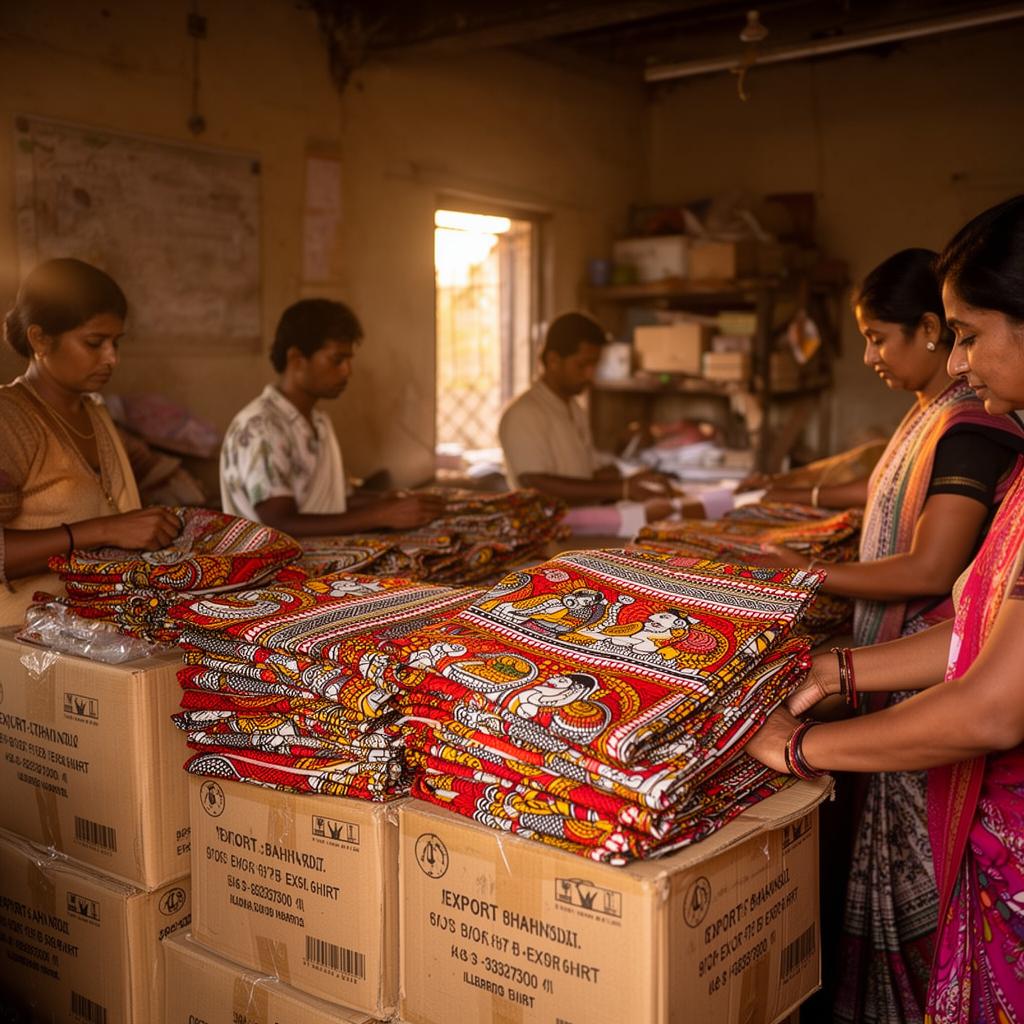
By FY20 he had registered an Importer-Exporter Code, opened a current account with an EEFC facility, and was shipping under his own AD code through the inland container depot at Raxaul, which had opened in 2017 and cut his logistics time to the eastern seaboard by roughly nine days. Turnover that year was ₹68 lakh. The pandemic almost ended the business — March to August 2020 produced zero shipments and he kept the cluster employed on a personal loan against his wife's now-recovered gold. By FY22, orders had resumed. FY24 closed at ₹2.7 crore, with 61% from exports.
6. What it actually takes.
It is tempting, and lazy, to write this as a story of one extraordinary man. Ramashankar is the first to refuse that frame. He will list, unprompted: Sunaina Devi, who runs quality control and who learned to read invoices in English from a Class 9 textbook; his son Abhay, who handles digital orders and customer service in Hindi, English and a working Japanese; the 22 painter households, of whom 17 are led by women and 9 are from Dalit families that were, until 2009, not commissioning directly from customers at all; the Jeevika federation officer in Madhubani who, in 2018, helped the cluster register as a Producer Company under Section 581C of the Companies Act, which gave them the legal form to receive overseas wire transfers.
What it took, in his telling, was four ordinary things in unusual combination: a ledger kept honestly for two decades; a willingness to ask for advance payment from a buyer he could not afford to offend; a smartphone in the hands of a teenager who was not afraid of it; and the geographic luck of being born close enough to an open border that a Japanese researcher could, on a March afternoon in 2016, walk into his courtyard.
None of that erases the floods, or the credit gap, or the fact that the road from Ranti to the Madhubani railway station still floods in three years out of five. It does, however, suggest that the binding constraints in north Bihar are not the ones most often listed in policy notes. They are not, primarily, talent or ambition or even capital. They are distance, document, and trust — and each of those is, in principle, solvable.
Ramashankar's youngest daughter, Ankita, is in Class 12. She wants to study textile engineering at NIFT Patna, which opened its campus in 2008 and admitted its first batch in 2010. If she gets in, she will be the first person in three generations of her family to leave the village for an institution, and the first her father intends to fund without a loan.
Reporting note — This piece is based on three site visits to Ranti between January and April, conversations with eleven members of the cluster, the Paswan family ledgers from 2005 onwards, and publicly available data from the 2011 Census, NITI Aayog, the Bihar Rural Livelihoods Promotion Society, and the Indian Institute of Foreign Trade. Names of family members are used with consent. Buyer names abroad have been generalised at their request.
Continue reading