The king who came for a cure — Mahendranath at Mehdar
Thirty-odd kilometres south of Siwan town, past sugarcane and a level crossing, a brick temple built for a Nepali king stands beside a lake the size of a small township. Every Shravan it receives more pilgrims in a single Monday than most of Bihar's ticketed monuments receive in a year — and almost none of that footfall shows up as an economy. This is a report on faith that works, and infrastructure that does not.
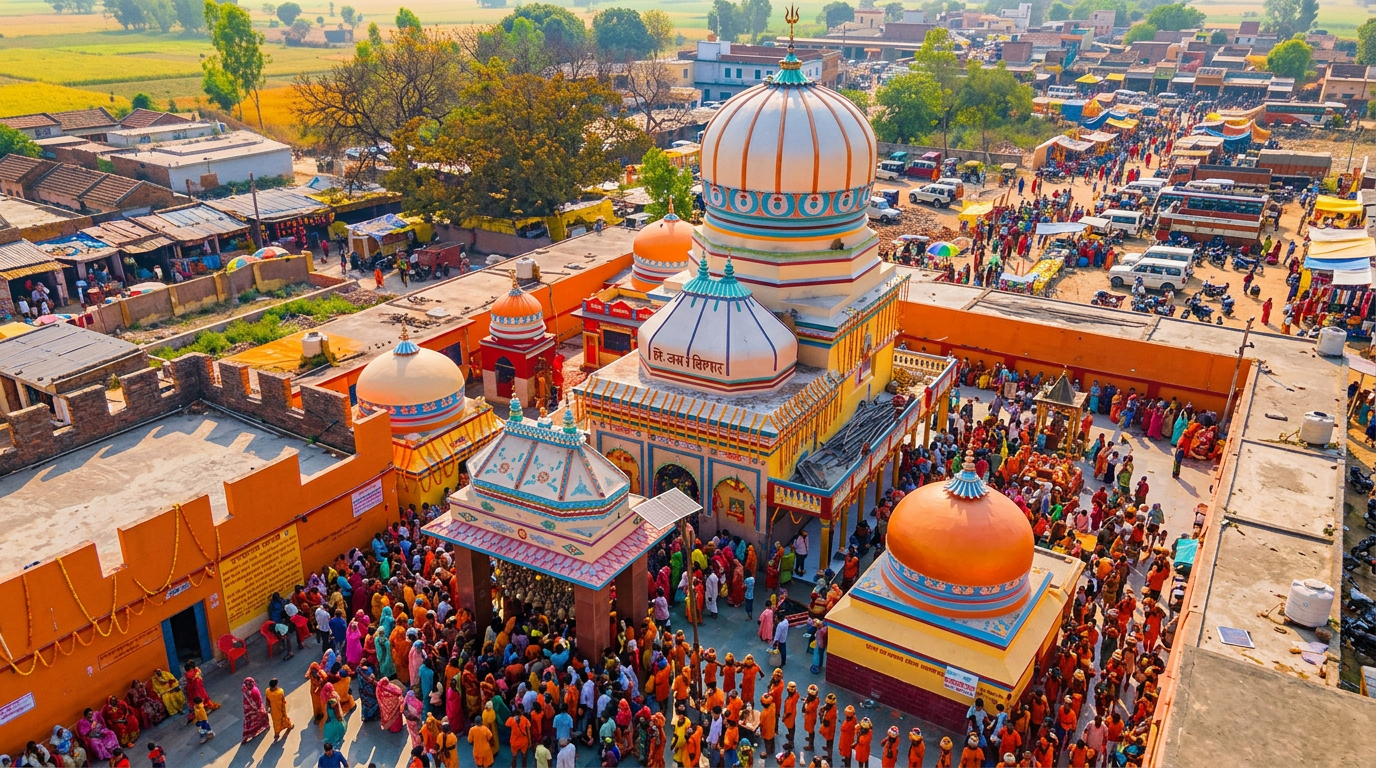
1. The road to Mehdar.
The last stretch into Mehdar does not announce itself. You leave Siwan town on the Chainpur road, pass Hasanpura, and for half an hour the landscape is the ordinary north-Bihar composite of sugarcane, standing water, brick kilns and the low blue shutters of a hundred repair shops. Then the road bends, the trees open, and there is water — a great deal of water, flat and grey in the morning, with a wall of temple brick on its edge and a queue of people already moving along it, each carrying a lota.
This is Mehdar Dham, formally the Mahendranath temple, in Siswan block of Siwan district, roughly 32 to 35 kilometres south of the district headquarters. It is one of the oldest continuously worshipped Shiva shrines in Bihar and, by the description used in both the Siwan district administration's own tourism listing and the Saran divisional record, a place that draws visitors "including foreigners, from far flung areas".
What strikes a first-time visitor is not the architecture. It is the ratio. A shrine of this pull — six-figure crowds on the big days, an annual state-recognised festival, a railway halt named after it — has, at the time of reporting, no interpretation centre, no published visitor count, no signage in English beyond a district board, no ticketed parking, and no hotel of any description within a comfortable radius. The faith is fully built. Everything around the faith is not.
2. A king, a peepal tree, a dream.
The founding story is told the same way by the district website, by the Hindi press, and by the priests who sit at the eastern gate, and it is worth telling in the order they tell it, because the order is the point.
A king of Nepal, named in the tradition as Mahendraveer Vikram Sahdev, was suffering from a chronic and disfiguring skin disease — the sources generally say leprosy. He set out for Kashi, the last address of the incurable, and his route took him through the forest that then covered this part of the Saran plain. Night fell; he camped. He washed his hands and face in a small pool of water beside a peepal tree, and — the story insists on this detail — the skin where the water had touched began to clear.
That night Shiva came to him in a dream and said, in effect: you have already arrived. Bathe in the pond; dig beneath the peepal. In the morning the king bathed, dug, and found a lingam in the earth. He performed the abhishek himself. His disease left him. He never reached Varanasi. Instead he built a temple over the lingam, had the pond excavated into a tank of fifty-two bighas, and gave the shrine his own name: Mahendranath — the lord of Mahendra.
Read as history, the legend is unverifiable; there is no inscription at the site, and the Wikipedia record for the temple notes the absence of any. Read as social memory, it is unusually informative. It records three things a modern reader should not skip: that this was a forested, thinly settled frontier before it was farmland; that the pilgrim traffic between the Himalayan kingdoms and Kashi ran directly through what is now Siwan; and that a ruler from outside Bihar considered it worth his treasury to sink a lake and raise a temple here. Mehdar was on a route. Bihar's supposed remoteness is a recent condition, not an ancient one.
On dating, the sources genuinely diverge, and we will not pretend otherwise. The English Wikipedia entry for Mahendra Nath Temple, Siwan gives an establishment date of 1523 CE while attributing construction to a seventeenth-century Nepali king — an internal contradiction it inherits from its own citations. The companion entry, Mahendranath Temple, calls it a sixteenth-century foundation. Regional Hindi reportage in Dainik Bhaskar runs with the round number the priests use: "500 years old." Local writing on MySiwan places the king in the seventeenth century while allowing that some accounts push the site's sanctity back to Pala or Sena times. The honest statement is this: the present structure is most plausibly late-medieval, between the early sixteenth and the seventeenth century; the worship at the spot is probably older than the structure; and nobody has yet done the archaeology that would settle it.
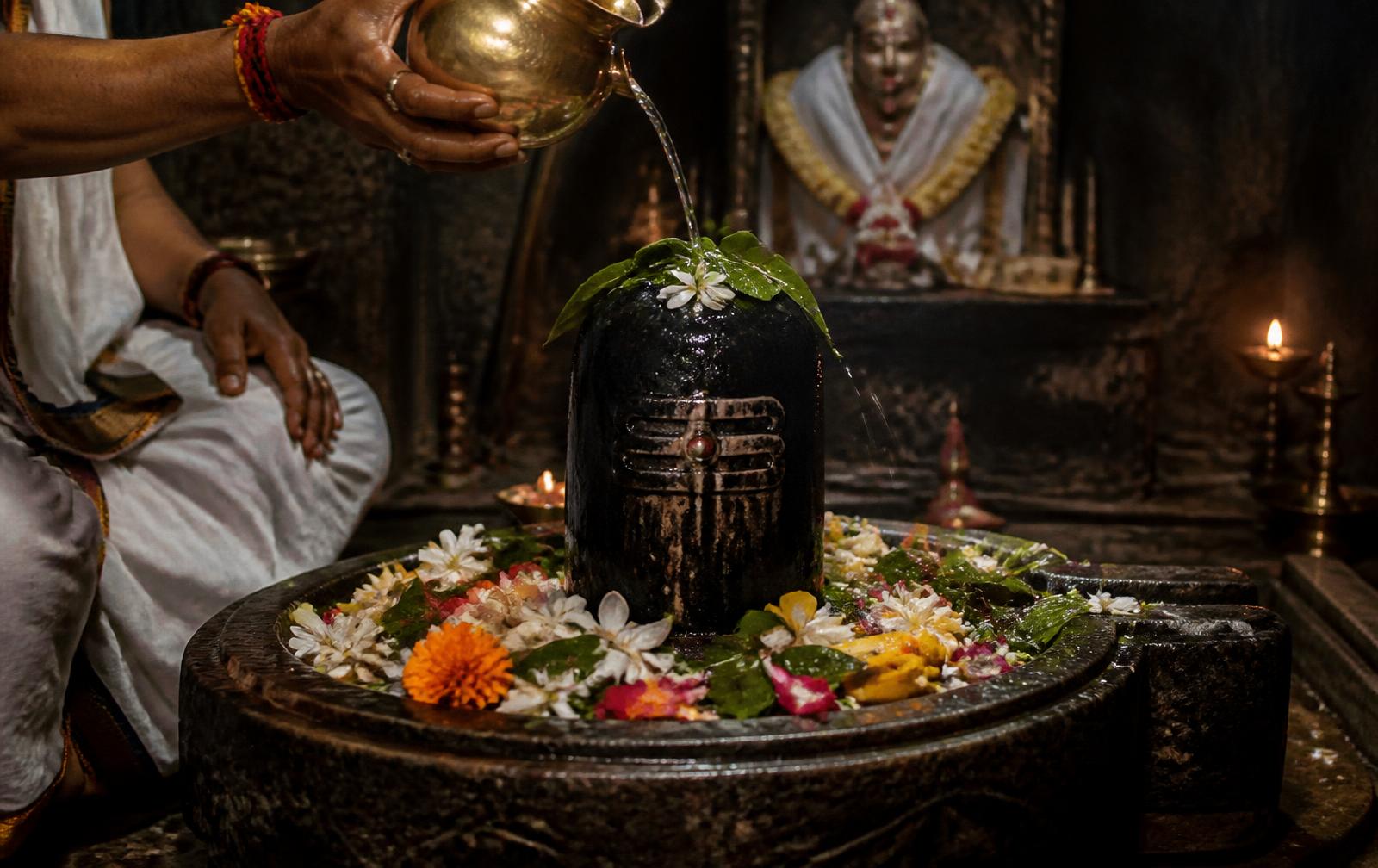
3. What the building actually says.
The temple is built of Lakhauri brick — the thin, flat, wafer-like brick of Mughal and post-Mughal north India — set in lime mortar. That single material fact is the strongest architectural argument for a late-medieval date: Lakhauri brick with lime is the signature technique of sixteenth- to eighteenth-century construction across the Gangetic plain, and it is not what a Pala-era builder would have used. Four centuries on, the walls are still load-bearing.
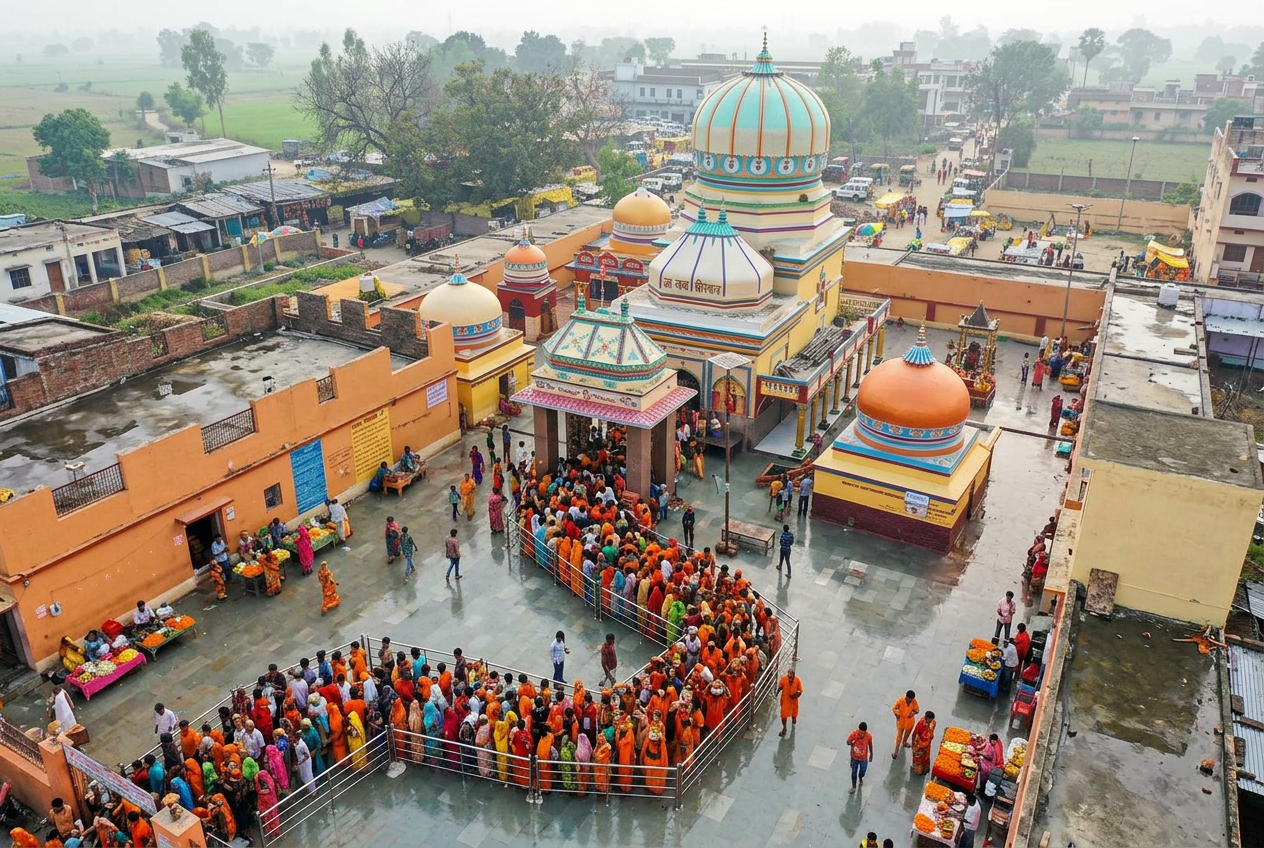
What you actually see on the skyline is not a classic Nagara spire but a cluster of bulbous, fluted, onion-profile domes — a tall central dome over the sanctum, flanked by smaller white and saffron-orange domes over the subsidiary shrines, each ringed with painted bands of turquoise, red and cream and capped by a kalash and a trishul. The standard accounts describe the composition as Nagara massing carrying strongly Vesara and late-Mughal inflections, and that is a fair description of what the eye reports: an indigenous plan wearing an eighteenth-century Gangetic dress. The sanctum, the garbhagriha, holds the swayambhu lingam.
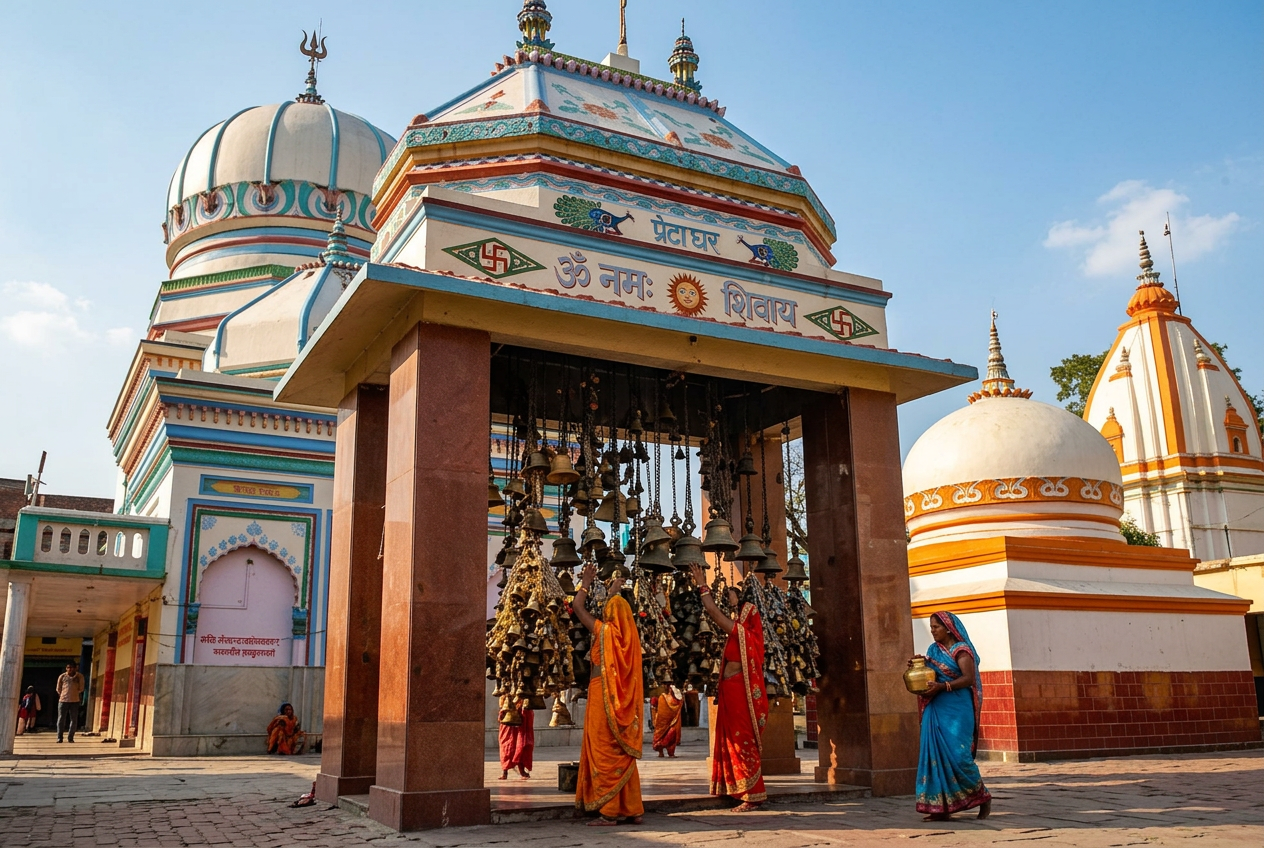
The entrance is the most elaborated element of the whole composition — which is normal for the region and the period, where the doorway rather than the spire carried the display. At Mehdar it is a low pillared gateway mandapa on red sandstone piers, its lintel painted with a sun disc, swastikas, peacocks and the Om Namah Shivaya legend, and its ceiling hung with several hundred brass bells left behind by petitioners whose wishes were granted. The bells, not the carving, are the archive here.
A caution that any honest heritage writing about Bihar has to include: Mehdar is a living temple, and living temples get repainted. The saffron, white and turquoise you see today is not the seventeenth-century surface; the tile work in the courtyard is contemporary; several subsidiary shrines are twentieth-century additions by donor families. This is not vandalism — it is how a functioning shrine stays functioning — but it does mean that no reliable stylistic dating can now be done from the visible surfaces alone. A measured drawing and a mortar analysis would answer in a fortnight questions the internet has been arguing about for a decade.
4. The 52-bigha lake.
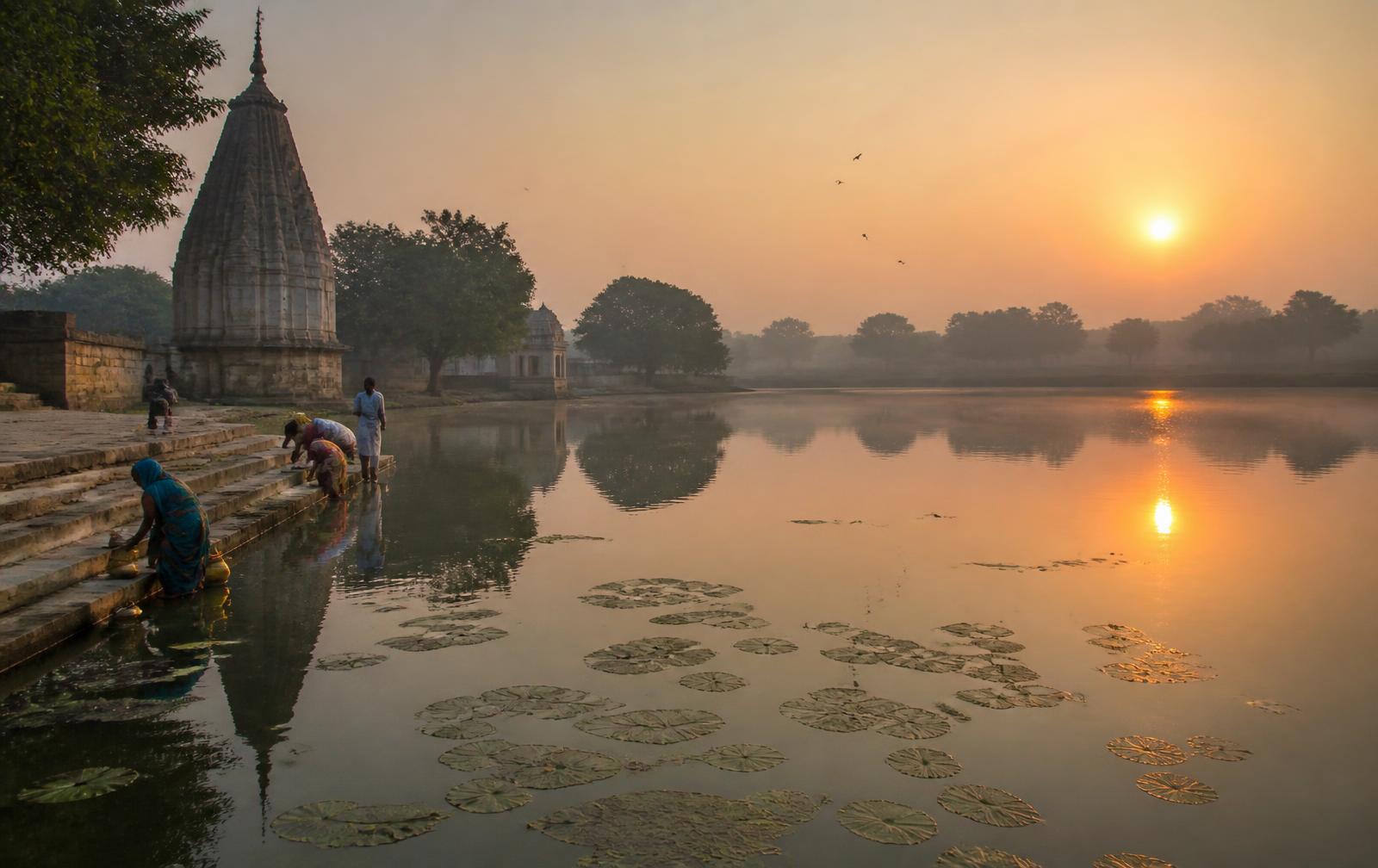
The Kamaldah Sarovar — the lotus tank — is the part of Mehdar that most visitors underestimate and that any planner should treat as the site's primary asset. The tradition puts it at fifty-two bighas. Bigha varies across Bihar, but on the commonly used north-Bihar reckoning of roughly 0.25 to 0.34 hectares, fifty-two bighas is somewhere between thirteen and eighteen hectares of open water: bigger than most urban parks in the state, and dug by hand.
Its function was never only devotional. A tank of that size in a flood-and-drought plain is groundwater recharge, dry-season irrigation reserve, fish, and a thermal buffer for the village around it. The bathing that precedes darshan at Mehdar — pilgrims bathe in the sarovar before offering water to the lingam — is the ritual that keeps the tank in public ownership and public interest. That is the medieval water-management model in one sentence: the temple guarantees the pond, and the pond guarantees the village.
Which is exactly why its condition matters. Local reporting in Dainik Bhaskar has framed Mehdar as becoming a centre of environmental protection alongside faith, and the temple's own administration has run plantation and cleanliness drives. But the pressures on a tank of this kind are standard and relentless across Bihar: silting, encroachment on the margins, plastic and cloth offerings, nutrient loading from bathing crowds, and the slow bureaucratic drift by which a water body listed in one revenue record simply stops appearing in the next. A desilting and hydrology study of Kamaldah would cost less than a single kilometre of state highway.
5. Shravan: the arithmetic of a Monday.
Mehdar has two calendars. For most of the year it is a village shrine with a steady local traffic — a few hundred a day, more on Mondays, weddings and mundan ceremonies in the courtyard, a handful of shops selling bel leaves, dhatura, milk sachets and marigold.
Then Shravan arrives, and the place becomes something else. On each of the month's Mondays, kanwariyas walk in with Ganga water — from the Saran ghats, from Chhapra, from across the Ghaghara in eastern Uttar Pradesh — and the approach road becomes a single moving column from before dawn. Mahashivratri brings the other peak, and the state government's own event calendar records the Mehdar Mahotsav, listed by the Siwan district administration as a formal district event with a multi-week window in the Mahashivratri season. Local accounts place attendance on the biggest day at "over a lakh".
Treat that number with care — there is no turnstile at Mehdar and no published methodology behind any figure quoted for it. But even a conservative reading is instructive. Suppose 60,000 visitors across a peak day and an average spend of ₹120 per head on offerings, prasad, tea, a meal and transport. That is roughly ₹72 lakh circulating in and around one village in twenty-four hours. Across the four or five Shravan Mondays plus Mahashivratri, the same arithmetic suggests a seasonal economy of the order of ₹4–5 crore — almost entirely informal, almost entirely uncaptured, and almost entirely reliant on a road, a halt station and a set of shoulder-wide lanes that were never designed for it.
Note what is absent from that spend: accommodation. There is no meaningful place to stay. Which means Mehdar is a day-trip shrine, which means its visitors leave before dark, which means the highest-value part of a pilgrimage economy — the overnight — is not merely underexploited here. It does not exist.
6. Why people come: children, skin, and the long wait.
Every major shrine specialises, and Mehdar's specialisation is precise. The district administration's own tourism page states it plainly: it is believed that by offering water to the Shivalinga at Mehdar, childless people are granted children and those with skin ailments find relief. The second promise follows directly from the founding legend — the king's leprosy — and the first is the near-universal petition brought to swayambhu lingams across the subcontinent.
It would be easy, and lazy, to write this off as superstition and move on. What it actually maps is a gap. Infertility care in rural Bihar is expensive, distant and socially punishing, and its burden falls almost entirely on women. Dermatology is one of the thinnest specialities in the state's public health cadre. A woman who has been told for eight years that her childlessness is her fault, and who has no affordable clinic within a day's travel, is not being irrational when she walks twenty kilometres with a pot of Ganga water. She is doing the only thing on offer that costs her nothing but her feet.
Which suggests a use for the crowd that nobody currently makes of it. A shrine that gathers tens of thousands of women with fertility anxieties and thousands of people with untreated skin conditions, on predictable dates, in one field, is — from a public health standpoint — the best outreach venue in the district. A dermatology and reproductive-health camp on the Shravan Mondays, run with the temple committee rather than against it, would reach a population that a primary health centre in Siswan will never see. Faith and medicine do not have to be rivals at Mehdar. They are queuing at the same gate, on the same morning, for the same reason.
7. The 2022 crush, and the cost of no plan.
On the first Monday of Shravan in July 2022, the crowd at Mehdar went out of control. Reports in India.com and AajTak described a stampede-like situation in the queue for jalabhishek; two women died, and several people were injured. Other accounts of the same day give a death toll of one. The discrepancy in the record is itself part of the story.
Crowd deaths at Indian shrines are almost never caused by panic. They are caused by geometry: a queue that narrows, a single gate serving both entry and exit, a barricade line placed for the convenience of the police rather than the flow of the crowd, and a density that crosses roughly five people per square metre, at which point the crowd behaves as a fluid and individual choice stops existing. Every one of those is a design problem with a known, cheap, well-documented solution: one-way circulation, separated darshan lanes, holding pens with timed release, shaded queue corridors with drinking water, and a marshalling cadre trained before the season rather than deployed during it.
None of that requires a new temple, a new road or a central scheme. It requires a crowd-management plan drawn once, by someone competent, and rehearsed annually. That Mehdar has drawn six-figure Shravan crowds for generations and lost lives in 2022 for want of a queue diagram is the most damning single fact in this report — and the easiest one to fix.
8. Siwan's other inheritance.
Siwan does not have a reputation problem because of its history. It has a reputation problem because of a period — the long decade in which the district's name in the national press was attached to a criminal politics that has since been dismantled in the courts. That story has been told exhaustively. What has not been told, with anything like the same energy, is the rest of the ledger.
This is the district of Dr Rajendra Prasad, born at Ziradei, first President of the Republic, whose ancestral house stands a short drive north of Mehdar and receives a fraction of the visitors it should. It is a district of serious out-migration and consequently of serious remittance, with families in the Gulf, in Delhi, in Kolkata and increasingly in North America. And it holds, in Mehdar, one of the two or three most-visited unrecognised heritage sites in western Bihar.
Bihar's tourism thinking has for two decades been organised around two circuits: the Buddhist one — Bodh Gaya, Rajgir, Nalanda, Vaishali — and the Patna–Ganga axis. Both deserve the attention. But both are in the south and centre of the state. North-western Bihar — Saran, Siwan, Gopalganj, West Champaran — has no comparable circuit, despite having Ziradei, Mehdar, the Ghaghara confluence, Sonepur's mela, and the Gandhian sites at Bettiah and Bhitiharwa within a few hours of one another. The absence is not for lack of material. It is for lack of a map.
9. What a working Mehdar would look like.
One — a crowd plan before the next Shravan. One-way circulation, separated entry and exit, timed holding, shaded queue with water and ORS, trained volunteer marshals drawn from the village, and an ambulance stationed on site on the peak days. Cost: lakhs, not crores. Deadline: the next monsoon, not the next five-year plan.
Two — settle the date. Commission a measured survey, photographic documentation and mortar analysis through the Bihar State Archaeology Directorate or a university department, and publish it. A temple that cannot say how old it is cannot be protected, funded or taught.
Three — treat Kamaldah as infrastructure. A hydrology and silt study, a demarcated boundary against encroachment, ghats that are safe for women to bathe from, and an offerings protocol that keeps cloth and plastic out of the water. A restored tank is worth more to Siswan block than a restored spire.
Four — build the overnight. Ten to fifteen homestays, certified and trained through the state tourism department, run by families in Mehdar and the surrounding villages. Not a hotel. Homestays keep the margin in the village, need no land acquisition, and can be operating within a year.
Five — draw the north-western circuit. Ziradei (Rajendra Prasad) — Mehdar (Mahendranath) — Sonepur — Chhapra, as a signed, mapped, two-day route with a single published itinerary, bus timings and a QR-coded interpretation board at each stop. The assets exist and are already connected by road. What is missing is the sentence that connects them.
Six — use the crowd for health. Dermatology and reproductive-health camps on Shravan Mondays and at Mahashivratri, run in partnership with the temple committee and district health administration. The congregation is already assembled; only the clinic is absent.
Seven — the diaspora ask. Siwan's people abroad send money home every month. A fraction of that, pooled and governed properly, could fund the interpretation centre, the queue infrastructure, the survey and the homestay training in a single cycle — without waiting for a line item in a state budget. This is precisely the kind of project Resurge Connect exists to route.
A king came here looking for a cure and found one, and out of gratitude he dug a lake and left a building. Four hundred years later the building still stands, the lake still holds water, and a hundred thousand people a year still walk in with the same expectation he had. The faith has done its part with remarkable consistency. What is owed in return is unglamorous: a queue diagram, a silt study, a dated survey, fifteen clean rooms, and a signpost on the Chainpur road. Bihar does not always need grand gestures. Sometimes it just needs someone to finish the job the king started.