The debate at Mahishi — when Bihar arbitrated India's mind.
Sometime in the 8th century, a barefoot monk in his early twenties walked across the subcontinent to a village in what is today Saharsa district. He had come to argue. The man he had come to argue with was the most respected householder-scholar of his age. The judge they both agreed to was a woman. Indian philosophy has not quite been the same since — and the address on the envelope was Bihar.
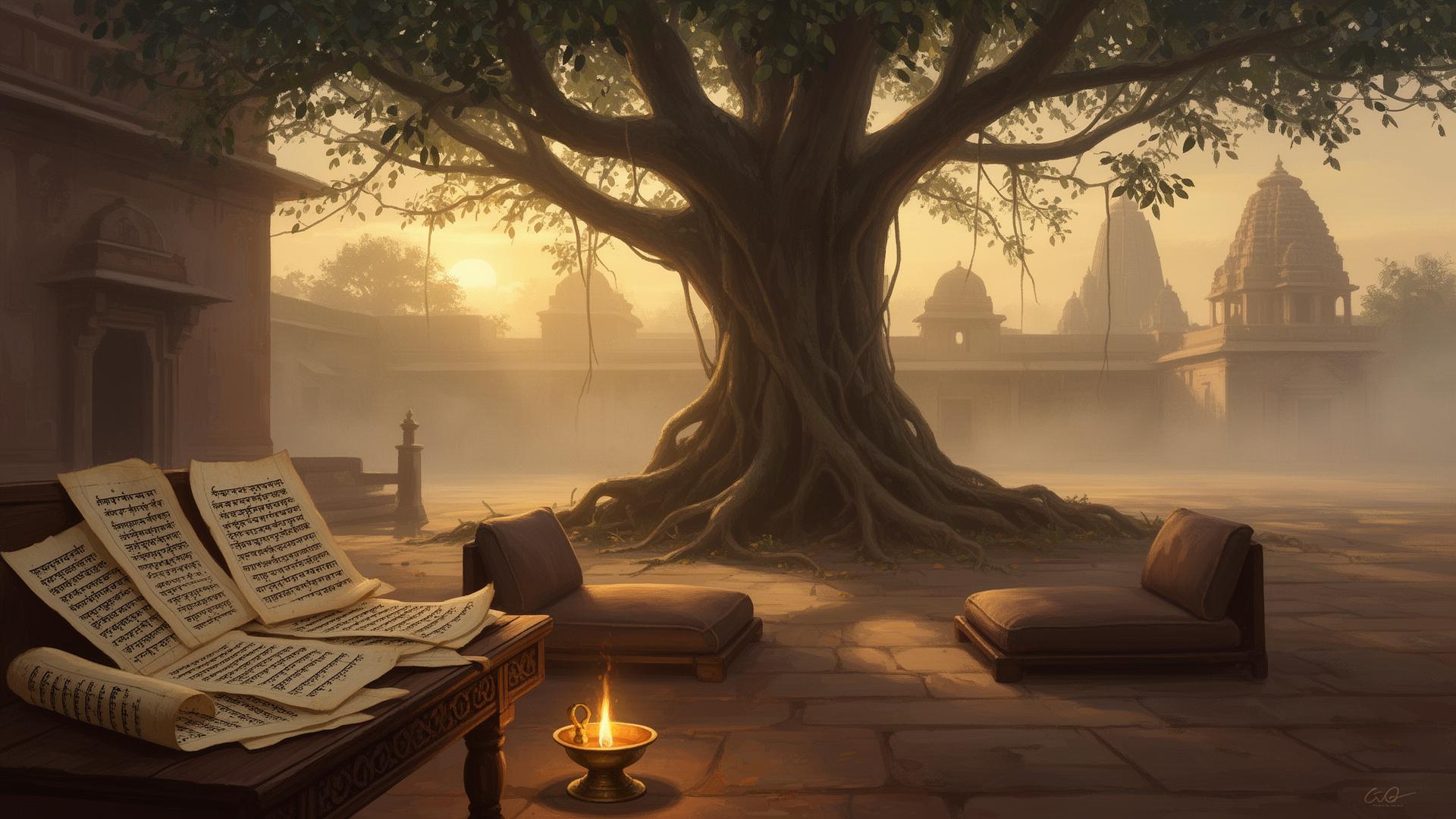
1. Why a debate, and why this one.
The story most Indians half-remember about Adi Shankaracharya is the bullet point: he revived Hindu philosophy, founded four monasteries on the four corners of the country, and died at thirty-two. The bullet point is true, and it is also useless. It hides the part of the story that actually mattered — the part where, before any of that empire-of-the-mind was built, he had to walk into a village in north Bihar and win an argument in public, in front of a referee chosen by his opponent, on terms his opponent accepted.
In the 8th century CE, India did not settle religious questions with violence. It settled them with śāstrārtha — a formal, public, often weeks-long oral debate, judged by neutral scholars, with the loser bound to accept the winner's path. Imagine, today, the Supreme Court hearing a constitutional matter, live, in a village square, with everyone in the district turning up to listen for a fortnight. That was the format. And in that format, the single most consequential hearing of the early medieval period was held not in Kanchipuram, not in Varanasi, not in Ujjain — but in Mahishi, in what is now Saharsa district of Bihar.
2. Who Mandan Mishra was.
To understand why this matters, you have to understand what kind of household Adi Shankara was walking into. Maṇḍana Miśra — Mandan Mishra, as Mithila remembers him — was a householder, a married man, and the leading living exponent of Pūrva Mīmāṃsā, the philosophical school that placed ritual action, duty and the Vedic word at the centre of human life. He was a student of Kumārila Bhaṭṭa, then the towering figure of the Mīmāṃsā tradition. Tradition holds his home was so saturated with learning that the parrots in the cages at his gate could recite Vedic grammar; travellers asking for directions to his house were told, simply, to follow the sound of the parrots.
This is not a quaint folk image. It is a statement about a kind of society Bihar then was. Mithila in the 8th century was a working ecosystem of Sanskrit grammar, logic (Nyāya), ritual science (Mīmāṃsā), poetics and astronomy, with patron families running residential schools —tols and pāṭhshālās — out of their own courtyards. To question Mandan Mishra in his own house was to question, in effect, the guild that ran the intellectual life of half a subcontinent.
3. Who the young monk was.
Adi Shankaracharya was, by all accounts, in his early twenties. He had been born in Kaladi in present-day Kerala, taken sannyāsa as a boy, studied under Govinda Bhagavatpāda on the banks of the Narmada, and was now travelling the country preaching Advaita Vedānta — the radical proposition that the self (ātman) and the ultimate reality (brahman) are not two things but one, and that ritual, however sincere, cannot deliver liberation; only direct knowledge of that non-duality can. He had already written commentaries on the Brahma Sūtras, the principal Upaniṣads and the Bhagavad Gītā. None of it would carry weight in north India unless the dominant school of the day publicly acknowledged it.
So he did the obvious, audacious thing. He walked to the strongest opponent of his thesis, in his opponent's own town, and asked for a hearing.
4. The argument, in plain language.
Strip the Sanskrit and the school names away, and the question was this. Does a human being become free by doing the right things — performing the prescribed rituals, fulfilling the duties of one's station, acting in the world with discipline — or by knowing a single underlying truth about the nature of reality? Mandan held that action, properly done, was the road. Shankara held that no amount of action could touch liberation, because liberation is not a thing produced; it is a fact recognised. Action belongs to the world of cause and effect; the self does not.
This is not a small distinction. It changes how a society organises itself. If ritual action is the path, the priest, the householder and the duty-bound citizen are the spiritual centre of gravity. If direct knowledge is the path, the renunciate, the teacher and the contemplative are. The argument at Mahishi was, in slow motion, an argument about who India should listen to for the next thousand years.
The terms were set before the first verse was spoken. Each man would defend his school. The loser would accept the life of the winner. If Shankara lost, he would marry, become a householder, and abandon his order of monks. If Mandan lost, he would renounce his home, his books, his standing, and take sannyāsa. The arbiter, both men agreed, would be the only person in Mahishi capable of judging them on level ground: Mandan's own wife.
"Where action ends, knowledge begins; and where knowledge dawns, action has nothing left to do."
5. The woman who turned the verdict.
Her name was Ubhaya Bhāratī, or simply Bhāratī — said by tradition to be an incarnation of Saraswatī, the goddess of learning. The honorific Ubhaya, "of both", described what she was uniquely qualified to do: judge both sides. She was a scholar of Mīmāṃsā in her own right, married into the household, and accepted by both debaters as neutral. Pause on that for a moment. In 8th-century Mithila, in a public theological dispute of national consequence, the agreed-upon referee was a woman, and nobody in the audience thought this remarkable enough to argue with.
The debate, by most accounts, lasted weeks. Bhāratī weighed the arguments day by day, often interrupting both men to sharpen their own points back at them. At the end of it, she ruled in favour of the young monk. Mandan prepared to accept the terms and take sannyāsa. And then Bhāratī did the thing that has made this story survive twelve centuries — she announced that the contest was not over. A husband and wife are ardhāṅginī, two halves of one whole; defeating only one half could not be called a complete victory. She would take her husband's seat and continue the debate.
She then chose her ground with deadly precision. She questioned Shankara on kāmaśāstra — the science of erotic love and householder life — a domain a celibate young renunciate could not possibly answer from experience. Shankara asked for, and was granted, a recess. In that recess, according to the tradition preserved by his biographer Mādhavīya, he performed parakāyā praveśa — entering the body of a recently deceased king — long enough to gain the knowledge he lacked, and returned to Mahishi to complete the answer. Bhāratī, at the end of it, accepted his argument. Mandan took sannyāsa under the new name Sureshvara, and went on to become the first head of Shankara's Sringeri monastery in the south — one of the four maṭhas that organise Hindu monastic life to this day.
Read the sequence again. A young monk from Kerala. A senior householder from Mithila. A woman judge accepted by both. A loser who became the next great teacher in his rival's school. None of this happened in a court. It happened in a courtyard. In Saharsa.
6. Why Mahishi, and why Bihar.
Mahishi did not host this debate by accident. North Bihar in that period — Mithila, Vaishali, Magadha, Anga — was the densest concentration of organised learning in the subcontinent and arguably in the world. Nālandā, an hour south of Patna, was running a residential university of an estimated ten thousand students and two thousand teachers, with a library so vast that when it burned, it is said to have smouldered for months. Vikramaśilā in Bhagalpur and Odantapurī in Nalanda were sister institutions. Mithila, ringed by Darbhanga, Madhubani and Saharsa, was the heartland of Nyāyalogic — the school that gave classical India its formal grammar of inference, and whose vocabulary still sits inside modern Indian legal reasoning. Earlier centuries had given Bihar the historical Buddha at Bodh Gaya, the historical Mahāvīra at Vaishali, the political theorist Kauṭilya at Pāṭaliputra, the astronomer Āryabhaṭa at Kusumapura, and the grammarian Pāṇini's most influential commentators.
This is the soil into which Shankara walked. He chose Mithila because it was the appellate court of Indian thought. A verdict that held up here would hold up anywhere. The verdict held. He went on, in the short remaining years of his life, to debate his way across the country and to establish the four maṭhas at Sringeri (south), Dvārakā (west), Puri (east) and Jyotirmaṭh (north) — but the foundation stone of that architecture was laid in a Saharsa village.
Mahishi remembers. The village is still associated with the Ugratārā temple, one of the oldest tantric Śākta shrines in Mithila, said by local tradition to have been visited and consecrated by Shankara himself after the debate. The site identified as Mandan Bhawan — Mandan Mishra's house — is still marked. Saraswatī Pūjā is celebrated in Mahishi with a particular intensity that the rest of Bihar treats as ordinary, and the rest of India has largely never heard about.
7. What we have forgotten.
Walk through a school in Patna, Saharsa, Gaya or Muzaffarpur today and ask a Class X student to name three philosophers born in Bihar. You will, more often than not, get a long pause. Ask the same student to name three cricketers, three film stars, three IAS toppers, and the answers will come back fluently. None of this is the student's fault. It is the consequence of a syllabus and a public culture that have, for a generation, treated Bihar's glory as a tourism brochure rather than as a working inheritance.
The bare list of what Bihar gave Indian thought is staggering, and worth saying out loud. Two of the world's living religions — Buddhism and Jainism — took their final shape here. Nālandā ran for roughly seven centuries as a residential university whose alumni shaped Tibetan, Chinese, Korean, Japanese and Southeast Asian Buddhism. Mithila gave India the Navya-Nyāya school of logic, refined by Gaṅgeśa Upādhyāya at Mithila in the 12th–13th century, and whose technical vocabulary is still in use in contemporary analytic philosophy departments. Vidyāpati, the 14th–15th century poet of Mithila, wrote in Maithili and shaped the Bhakti idiom of Bengal and Assam. Kabīr walked these roads. Guru Gobind Singh was born in Patna. Bābū Kunwar Singh led the 1857 uprising from Jagdishpur. Dr Rajendra Prasad — the first President of the Indian Republic — was a Bihari. The list is not a list of exceptions. It is the standard rate of return on a soil that took learning seriously.
Forgetting Mahishi is not a small forgetting. It is a sample of the larger amnesia. The state that once arbitrated India's mind has been told, for long enough that it has half-believed it, that its only relationship with knowledge is as a labour-exporter to other people's classrooms.
8. How we make Bihar the land of knowledge again.
The way back is not nostalgia. The way back is plumbing. If we want the next generation in Bihar to inherit pride in the Mahishi debate the way a child in Athens inherits pride in Socrates, the work is concrete, and most of it is unglamorous. A short list, in the order it can be done.
One — put the story into the syllabus. Mahishi, Mandan Mishra, Ubhaya Bhāratī, Gaṅgeśa, Vidyāpati, Āryabhaṭa, Kauṭilya and Nālandā belong in the Class VI–X social science and language textbooks of every board operating in Bihar — BSEB, CBSE, ICSE — not as appendices but as the main narrative of the state's history. A child should leave Class X knowing that the person who decided India's most important 8th-century debate was a woman from Mithila, and able to say her name without a prompt.
Two — restore the physical sites as living places, not ruins.Mahishi, Vikramaśilā, Nālandā, the Mithila Sanskrit institutions in Darbhanga, the Pāli archives at Nava Nālandā Mahāvihāra — each of these needs a small, well-curated interpretation centre that a school party from Saharsa or Begusarai can visit in a day. Not a sound-and-light show. A clean room with the original texts displayed, the argument explained in Hindi, Maithili, Bhojpuri, Magahi and English, and a librarian who knows the material.
Three — fund the chairs, not just the monuments. A single endowed chair in Mīmāṃsā at a Mithila university, a single endowed chair in Navya-Nyāya at Patna University, a single fellowship programme for young scholars working on Pāli and Prākrit — these cost less per year than a district-level festival, and they keep the chain of transmission alive. Without active scholars, monuments are mausoleums.
Four — back the modern descendants of the tradition. Bihar's contemporary knowledge economy — IIT Patna, NIT Patna, IIM Bodh Gaya, AIIMS Patna, Chanakya National Law University, the revived Nālandā University at Rajgir, Nava Nālandā Mahāvihāra, the Kameshwar Singh Darbhanga Sanskrit University — is the most natural inheritor of the Mahishi spirit. Industry, diaspora and state policy can route research grants, internships and visiting faculty programmes through these institutions deliberately, on the explicit understanding that they sit on a thousand-year stack.
Five — make the diaspora a faculty. Every Bihari professor abroad — and there are thousands, at MIT, Stanford, Oxford, NUS, IISc — is a potential one-week visiting lecturer at a college in Madhubani, Bhagalpur or Saharsa. A coordinated programme that flies them home, at the state's expense, for a single annual teaching week, would do more for the morale of a small-town undergraduate than any number of motivational posters.
Six — change the tone of the conversation at home. The generation now in school in Bihar will inherit whatever tone it hears at the dinner table. If the dinner table treats the state as a punchline, the child will repeat the punchline. If the dinner table treats the state as the place that judged Shankara — and got the judgement right — the child will repeat that. Pride is, in the end, a domestic decision.
Mahishi is not a memorial. It is an instruction. The instruction is that the most important arguments of an age should be welcome here, and that we should be confident enough to host them, learned enough to judge them, and fair enough to declare a winner who came from outside. The seats under the banyan are still there. The question is whether we are willing, again, to sit down.