Nalanda is rising again — quietly, deliberately, and on its own terms.
Eight hundred and thirty-one years after Bakhtiyar Khilji's army set fire to a library that reportedly burned for three months, the world's oldest residential university has reopened beside its own ruins. The new campus is 455 acres, net-zero, designed by the studio that B.V. Doshi built, and hosts scholars from seventeen countries. It is also, quietly, one of the most ambitious civilisational bets India has made in a generation.
1. What was lost.
Before there was Oxford, before Bologna, before the Sorbonne had even been imagined, there was a walled city of scholars on the alluvial plain south of the Ganga where the kingdom of Magadh thinned into rice-fields. Nalanda Mahavihara was founded around 427 CE under the Gupta emperor Kumaragupta I, and over the next seven hundred years it grew into something the modern world has no exact word for: part monastery, part research university, part civilisational archive. At its height in the 7th century it housed roughly ten thousand students and two thousand teachers, drawn from Tibet, China, Korea, Japan, Persia, Sumatra, Java, Sri Lanka, and the Tamil south.
Admission was famously hard. The Chinese pilgrim-monk Yijing, who arrived in 673 CE and stayed for a decade, recorded that the dwarapala — the gatekeeper-scholar at the front arch — turned away seven of every ten candidates after an oral examination on grammar, logic, and the established commentaries. Those who passed studied not only Buddhist philosophy but also medicine, mathematics, astronomy, metallurgy, public administration, and at least three languages. Tuition, board, clothing, and medicine were free. The university was funded by the revenues of two hundred villages granted to it by successive kings — a model of public endowment that India would not see again at that scale until the late twentieth century.
Its library was called Dharmaganja, the Mountain of Truth. It occupied three multi-storeyed buildings — Ratnasagara (the Ocean of Jewels), Ratnodadhi (the Sea of Jewels), and Ratnaranjaka (the Jewel-Adorned). Ratnodadhi was said to be nine storeys tall. Manuscripts in Sanskrit, Pali, Prakrit, and Tibetan were copied there for export across Asia. When Xuanzang carried 657 volumes back to the Tang court in 645 CE on a caravan of twenty horses, every single text had been copied at Nalanda.
2. The walk Xuanzang made.
It is worth pausing on Xuanzang, because much of what we know about Nalanda — and most of what survived as physical description — comes from his account. The Chinese monk left Chang'an in 629 CE in defiance of an imperial travel ban, crossed the Taklamakan, climbed the Tian Shan, descended through Samarkand and Balkh, traversed the Khyber, and walked the length of the Gangetic plain to arrive at Nalanda in 637. He was thirty-five years old. He stayed five years.
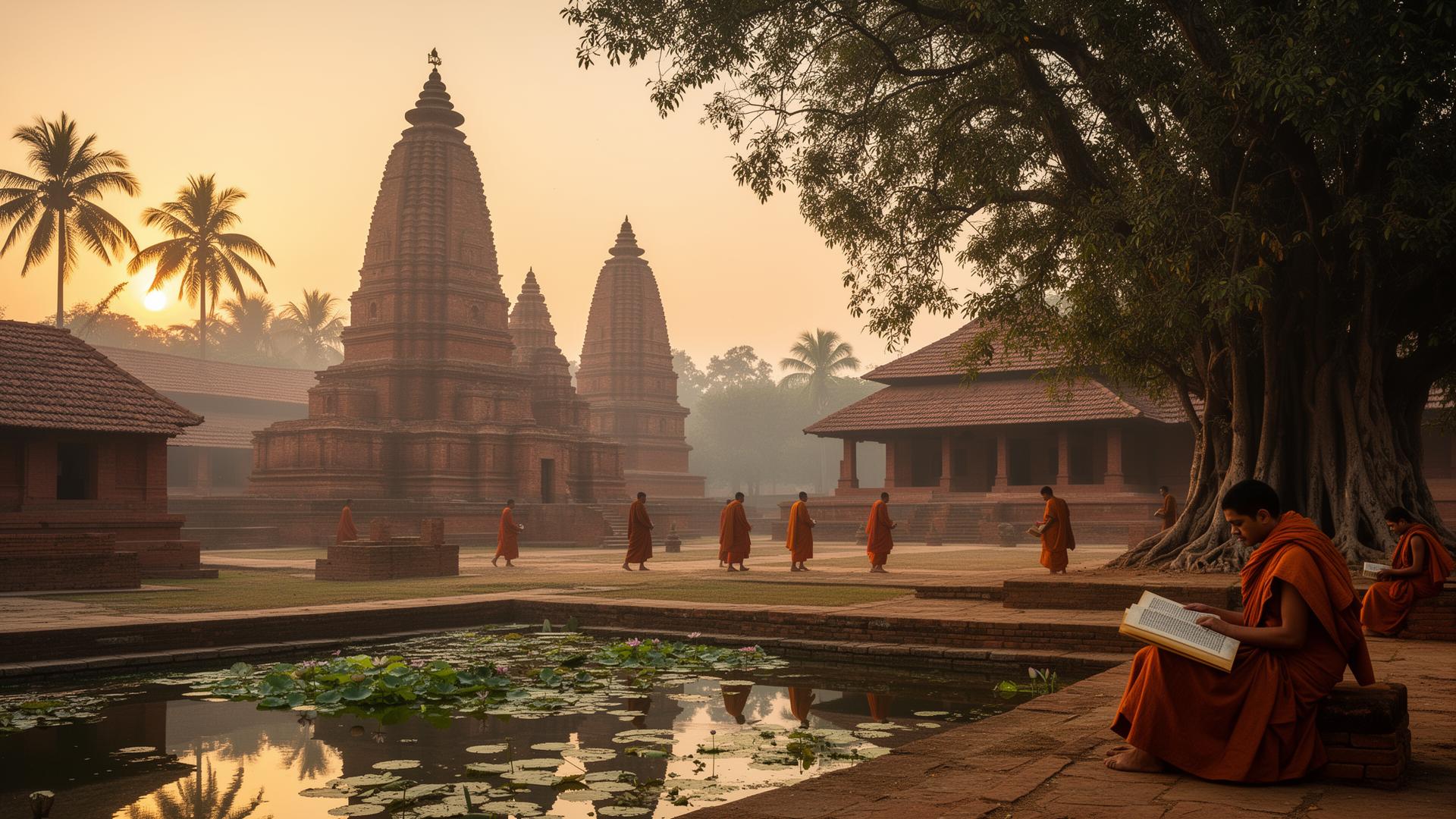
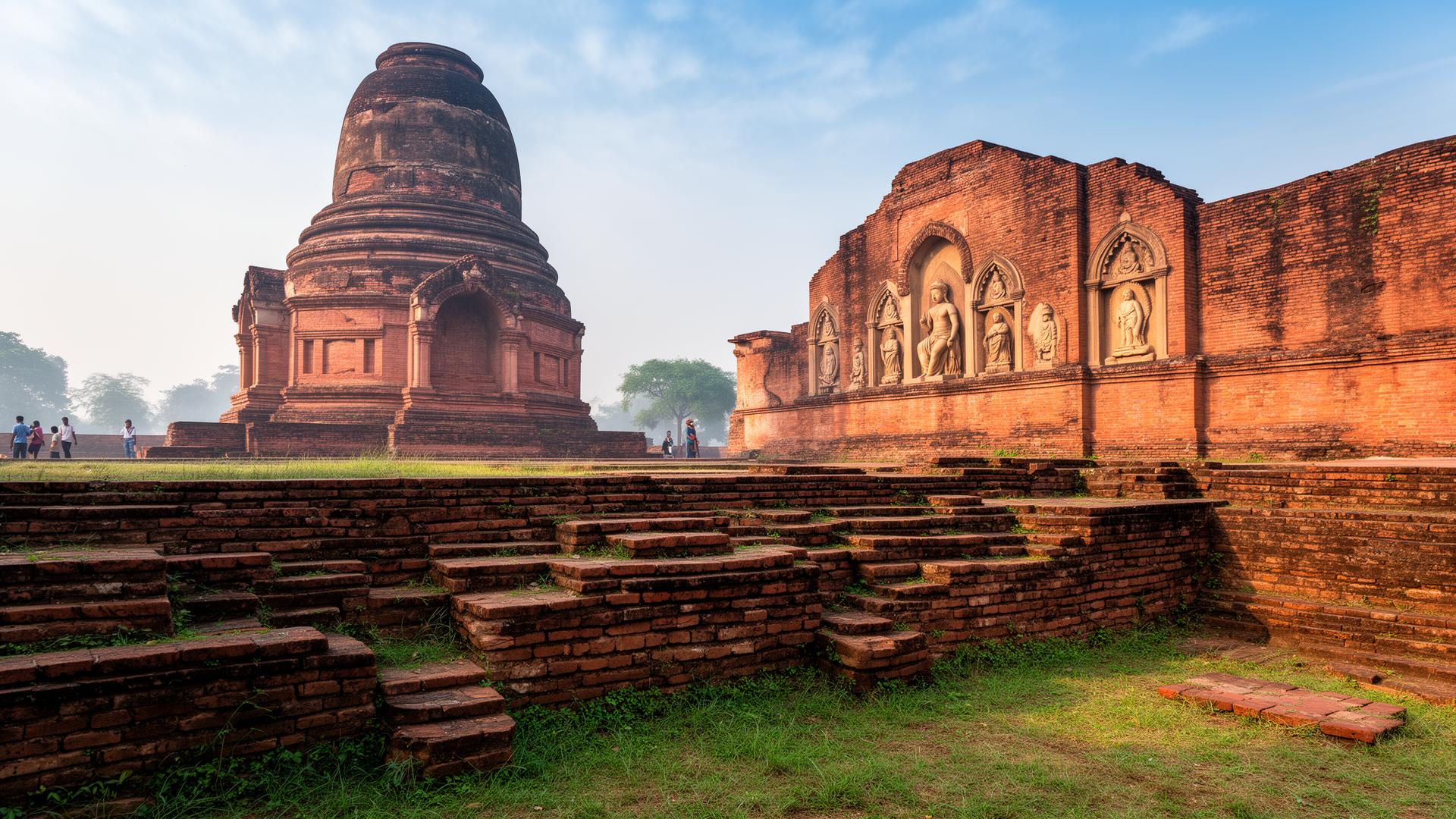
His record describes a campus enclosed by a high brick wall with a single great gate. Inside, eight separate compounds, ten temples, an observatory tall enough that "the clouds wandered past the windows," meditation halls, dormitory cells with stone beds, and a network of lotus tanks fed by an aqueduct from the hills at Rajgir. The architecture, he noted, was disciplined and warm — red brick laid in lime mortar, carved-stone door jambs, tiled roofs sloping over deep verandahs to keep out the sun and the monsoon. Anyone who has walked through the present-day excavated ruins at Nalanda will recognise the floor plan immediately. The bricks are the same colour. The proportions are the same. Only the roofs are missing.
"The day was not long enough for the asking and answering of profound questions. From morning till night, they engaged in discussion; the old and the young mutually helped one another."
Imagine, for a moment, the soundscape. A monk from Java, just arrived after a seven-month sea voyage, learning Sanskrit declensions in a courtyard. A debate in the medical hall on the properties of pippali (long pepper) as an antipyretic. Aryabhata's successors arguing about the precession of the equinoxes under the same banyan tree the Buddha had, according to local memory, walked beneath two centuries earlier. A king's emissary from Sumatra waiting respectfully in an outer room because a commentary on Dharmakirti's Pramanavarttika was being read out and could not be interrupted. This is not romance. This is what the records describe.
3. Three months of fire.
In or around 1193 CE — the date is debated within a decade — a cavalry force under Bakhtiyar Khilji, by then a Ghurid commander operating in eastern India, rode into Nalanda. The Persian chronicler Minhaj-i-Siraj, writing some fifty years later in the Tabaqat-i-Nasiri, records that the monks were killed, the temples broken, and the library set on fire. He adds, almost as an afterthought, that the books were so numerous that the smoke darkened the sky for many days. Later Tibetan accounts give a figure of three months. The number is unverifiable; the fact of catastrophic loss is not.
What burned at Nalanda has no modern equivalent. A working estimate from the historian D.R. Patil, based on the ratio of surviving Tibetan translations to lost Sanskrit originals, places the destroyed corpus at upwards of nine million manuscript folios — the bulk of north Indian Buddhist philosophy, much of the medical and mathematical tradition of the eastern Gangetic plain, and an unknowable quantity of Persian, Tibetan and Sinhalese material that had been gathered there for safekeeping. For the next eight hundred years, when anyone in Bihar said "we lost something," the unspoken referent was this.
The mound where the ruins lay was excavated only between 1915 and 1937 by Spooner, Hirananda Sastri, and the Archaeological Survey of India. Eleven monastic complexes and fourteen temples emerged from under twenty feet of silt. In 2016, after a quietly determined dossier prepared by the ASI and the Bihar government, UNESCO inscribed the archaeological remains of Nalanda Mahavihara on the World Heritage list. By then, another conversation had already been underway for more than a decade.
4. The idea returns.
The modern revival began not in Patna or Delhi but in two separate conversations that converged. In 2006, then President A.P.J. Abdul Kalam, addressing the Bihar Legislative Assembly, asked simply: "Why can we not have Nalanda again?" In parallel, the Singapore foreign minister George Yeo had been canvassing East Asia Summit governments on the case for a shared, sovereign-funded Asian university. By the 4th East Asia Summit at Cha-am, Thailand, in 2009, sixteen countries had endorsed the proposal. The Nalanda University Act was passed by the Indian Parliament in 2010 and notified in 2011.
The first Chancellor of the new university was the economist and Nobel laureate Amartya Sen, whose book The Argumentative Indian had argued, persuasively, that the pluralistic intellectual tradition Nalanda exemplified was native to the subcontinent long before it was imported back to it. The first Vice-Chancellor was Dr. Gopa Sabharwal. The first batch — fourteen students, two schools (Historical Studies and Ecology & Environment Studies) — began classes in September 2014 in temporary premises inside the Rajgir International Convention Centre. The land for the permanent campus — 455 acres on the road between Rajgir and the ancient site — had been donated by the Government of Bihar.
Progress, in the years that followed, was neither quick nor uncontested. Sen stepped down in 2015 after his term was not extended. George Yeo took over as Chancellor and served from 2016 to 2018. Vijay Bhatkar, the supercomputer engineer, succeeded him. In 2024 the chancellorship passed to the economist Arvind Panagariya. Vice-chancellors changed; budgets were rebalanced; the architectural brief was revised more than once. The university kept teaching through all of it. By 2023, it was running six schools and enrolling students from twenty countries, all from within the rented premises.
And then, on 19 June 2024, Prime Minister Narendra Modi cut a ribbon at Rajgir, with the foreign minister S. Jaishankar and the ambassadors of seventeen countries — Australia, Bangladesh, Bhutan, Brunei, Cambodia, China, Indonesia, Laos, Mauritius, Myanmar, New Zealand, Portugal, Singapore, South Korea, Sri Lanka, Thailand and Vietnam — standing behind him. He visited the ancient ruins first, then walked the kilometre to the new campus. His remarks at the dais were carried live on Doordarshan and across the region.
"Fire can burn books, but it cannot destroy knowledge. Nalanda is not just a name. It is an identity. It is a respect. It is a value, a mantra, a pride, a saga. Today, India is giving its ancient heritage a modern form."
5. A campus that breathes.
The new campus was designed by Vastu Shilpa Sangath — the Ahmedabad studio founded in 1955 by the Pritzker laureate B.V. Doshi, and one of the very few Indian practices with the institutional memory to attempt a project of this scale and symbolism. Doshi did not live to see it inaugurated; he passed away in January 2023. His students and his son-in-law's team carried the brief to completion. The instruction, repeated to anyone who would listen, was: do not reconstruct Nalanda. Translate it.
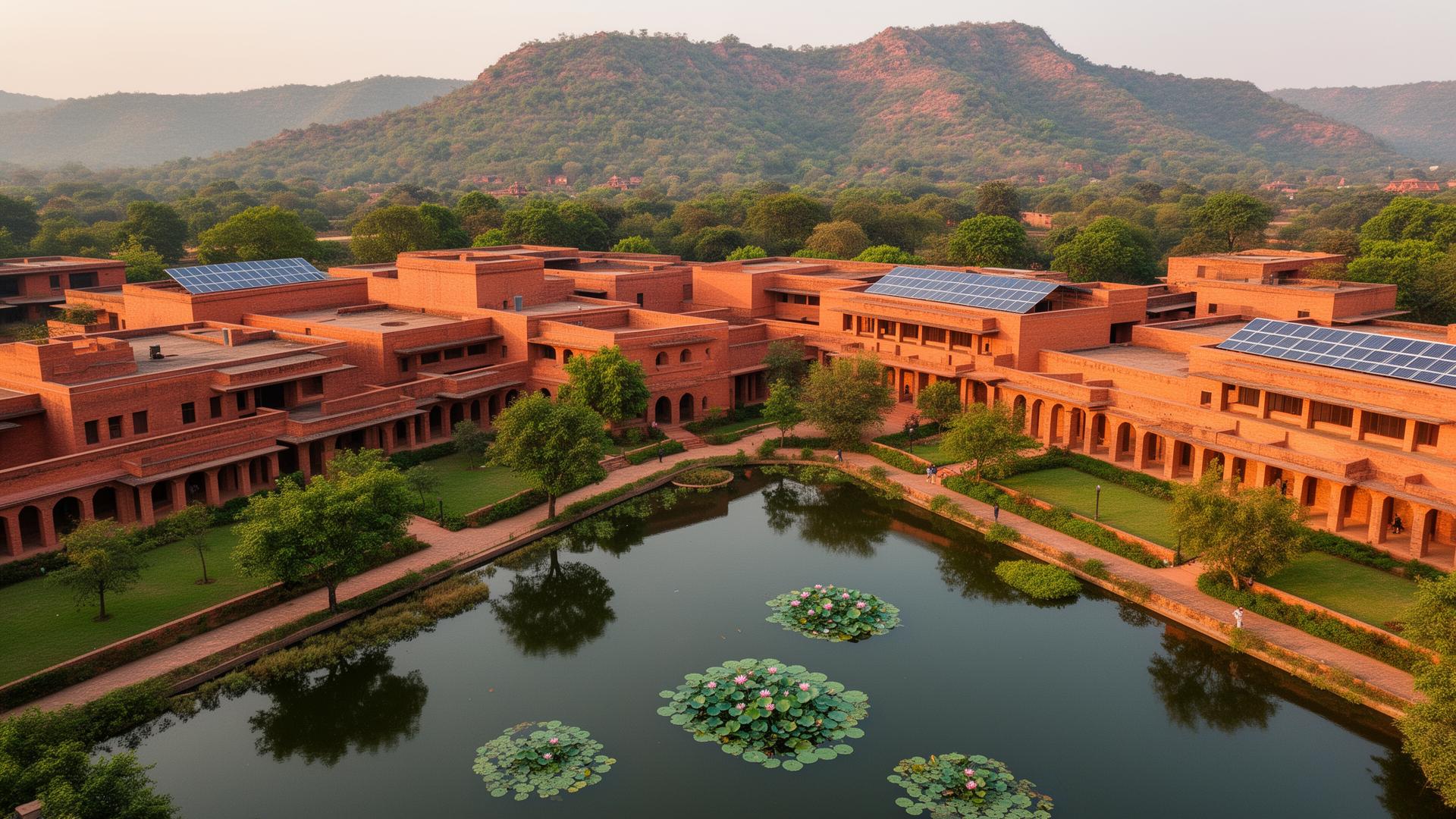
What that meant in practice is visible the moment you arrive. The buildings are low-rise — almost none above three storeys — and laid out around interlinked courtyards in the manner of the original eight viharas. The material is local burnt brick in a warm terracotta tone, deliberately echoing the colour of the excavated ruins a kilometre to the east. Roofs are deeply overhung; corridors are arched and shaded; cross-ventilation is achieved by the geometry of the windows, not by air-conditioning. Two academic blocks share a single library. The central spine of the campus runs north-south, mirroring the orientation Xuanzang recorded.
And then there is the engineering. The campus is designed to operate as net-zero in energy, water and waste — among a small number of university campuses in India that attempt all three. Rooftops carry a 6.5 MW solar plant. Two on-site treatment plants — one for drinking water, one for domestic wastewater — close the water loop. Sewage is routed to a biogas digester that supplies a portion of the kitchens. Roughly a hundred acres of the campus are given over to constructed wetlands, lotus tanks, and recharge ponds that double as the thermal regulator for the surrounding buildings. The campus is cooler by four to six degrees Celsius than the Rajgir town centre on a May afternoon — measured, not asserted.
6. The visitors.
One of the quieter pleasures of Nalanda's return is how it has begun to draw, again, the kind of visitor who once made the original walk. The Dalai Lama, who has long described himself as "a son of Nalanda" and traces his own monastic lineage to the Madhyamaka tradition that the mahavihara codified, has spoken of the revival as a matter of personal joy. Foreign ministers from Vietnam, Indonesia and Sri Lanka have visited the campus in the past year. The Thai Sangharaja sent a delegation in October. The Bhutanese royal family endowed a small reading room in the Buddhist Studies wing.
George Yeo, the Singapore statesman who shepherded the project through its first diplomatic decade and is among the most thoughtful commentators on its meaning, has framed it this way:
"Nalanda is not a Buddhist project, or an Indian project, or even an Asian project. It is a project about whether the human mind can recover what it once held, and add to it. The new campus is the easy part. The harder part will take a generation."
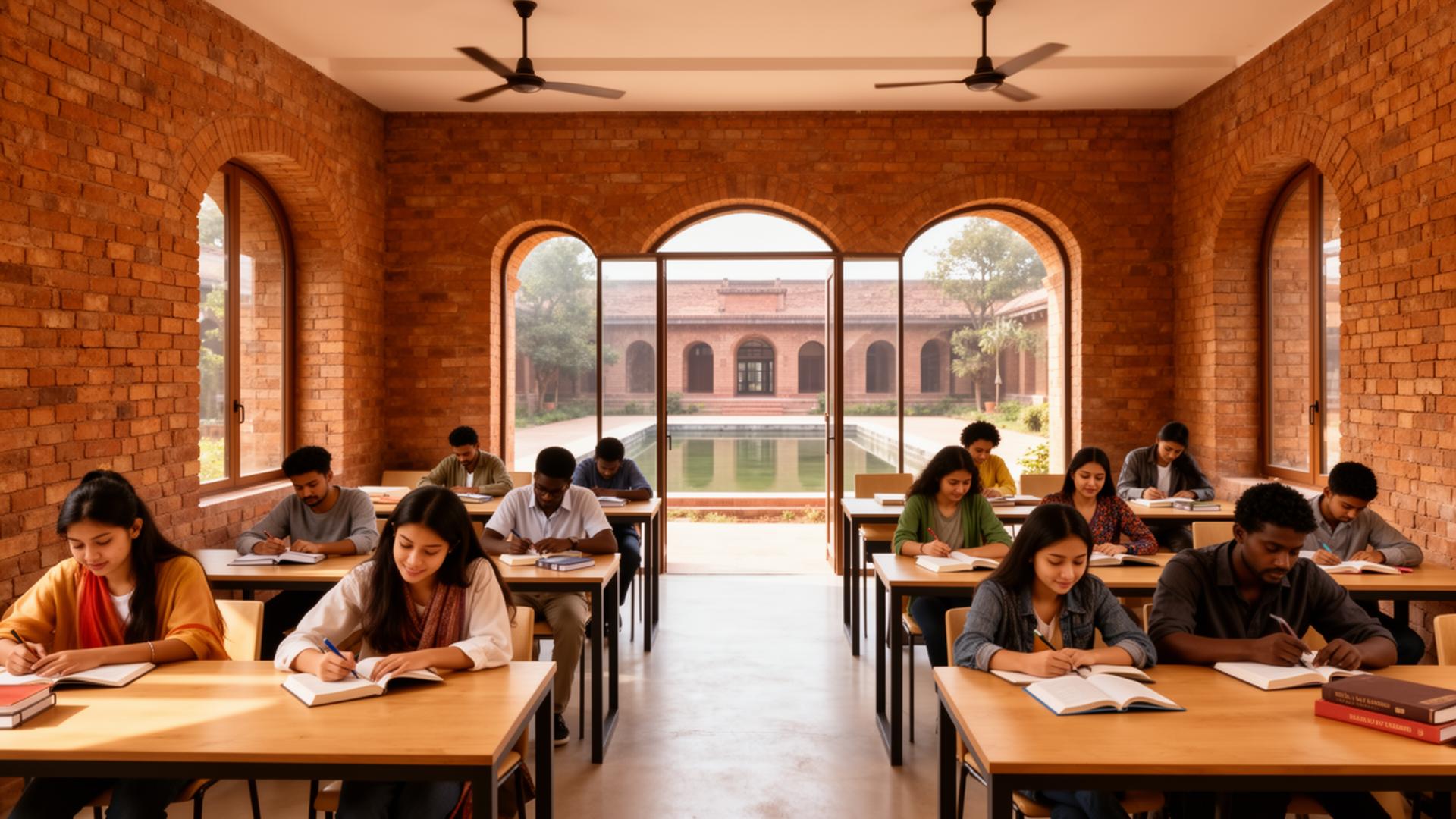
Amartya Sen, in a quieter register, has said that what matters now is the texture of the scholarship — whether the new Nalanda becomes a place where, as in the old one, an astronomer from Korea and a logician from Sri Lanka can disagree about epistemology in the morning and share the same kitchen by evening. The early signs are encouraging. The current student body of around 700 includes fellows from Mongolia, Tibet (in exile), Bangladesh, Bhutan, Sri Lanka, Myanmar, Thailand, Vietnam, Cambodia, Laos, Indonesia, South Korea, Japan, Mauritius, Argentina, Russia, the Czech Republic and the United States. The teaching languages are English and Pali, with Sanskrit, Tibetan and Mandarin offered.
Six schools are now operational: Buddhist Studies, Philosophy and Comparative Religions; Historical Studies; Ecology and Environment Studies; Sustainable Development and Management; International Relations and Peace Studies; and Languages and Literature. A School of Public Health and a Faculty of Indic Knowledge Systems are under design. The library, as a deliberate gesture, has been named Dharmaganja.
7. What it could become.
It would be unwise, and unlike Bihar, to claim too much too soon. The new Nalanda is fourteen years old as an institution and barely two as a built campus. Its endowment is modest by global comparison. Its research output is still building. The road from Patna airport, ninety kilometres away, is finally a four-lane highway but in places remains stubbornly two. Faculty recruitment, particularly in the harder sciences, is competitive against better-funded peers. None of these are romantic problems. All of them are solvable.
What the project has already done, and what is perhaps more important than any single metric, is to restore a certain kind of self-image to Bihar. For most of the last century the state has been written about — and, often, has written about itself — in the grammar of deficit: of what it lacks, of where it ranks, of who has left. Nalanda, carefully and without triumphalism, offers a different grammar. The first university in the world is being rebuilt, by India, in Bihar, with the cooperation of seventeen countries, to a design that meets the highest standards of contemporary sustainable architecture, on the same plain where it stood eight centuries ago. This is not nostalgia. It is infrastructure.
And it is, also, an invitation. To the Korean post-doc who has never been east of Seoul. To the Tamil philosophy student who has only ever read about the Pramanavarttika debates. To the Bihari schoolchild from Nawada or Saran who, until now, was told that the world's great universities were always somewhere else. To the pilgrim, the tourist, the historian, the engineer interested in net-zero buildings, the diplomat, the curious. The gate is open. The walk, as Xuanzang would tell you, is worth it.
On a recent evening at the campus, as the sun set behind the Rajgir hills and the lotus tanks turned a brief, improbable copper, an undergraduate from Vientiane was reading aloud from a Pali grammar to a friend from Yogyakarta who was correcting his pronunciation in laughter. A staff member walked past with a clipboard. The kitchens began to smell of dal. Somewhere a generator did not switch on, because it did not need to. The library lights, run from the day's stored sun, came on of their own accord. This is what a civilisation looks like when it is putting itself back together. Quietly. Deliberately. On its own terms.
Reporting note — This essay draws on site visits to the new Nalanda University campus and to the archaeological ruins between October 2024 and March 2025; on Xuanzang's Da Tang Xi Yu Ji and Yijing's Nan Hai Ji Gui Nei Fa Zhuan in English translation; on the Tabaqat-i-Nasiri; on the Nalanda University Act (2010); on the campus master plan brief released by Vastu Shilpa Sangath; on press coverage of the 19 June 2024 inauguration; and on published remarks by Amartya Sen and George Yeo. Quotes are reproduced as recorded; minor modernisations of punctuation are the author's.
Continue reading