Where India remembers.
A few grains of rice, a little water, a name spoken aloud. Every year, families bring these small things to Gayaji and ask them to carry something immeasurably large: remembrance. The rituals, the legends and the long history behind India's pilgrimage of gratitude.
1. A season set aside.
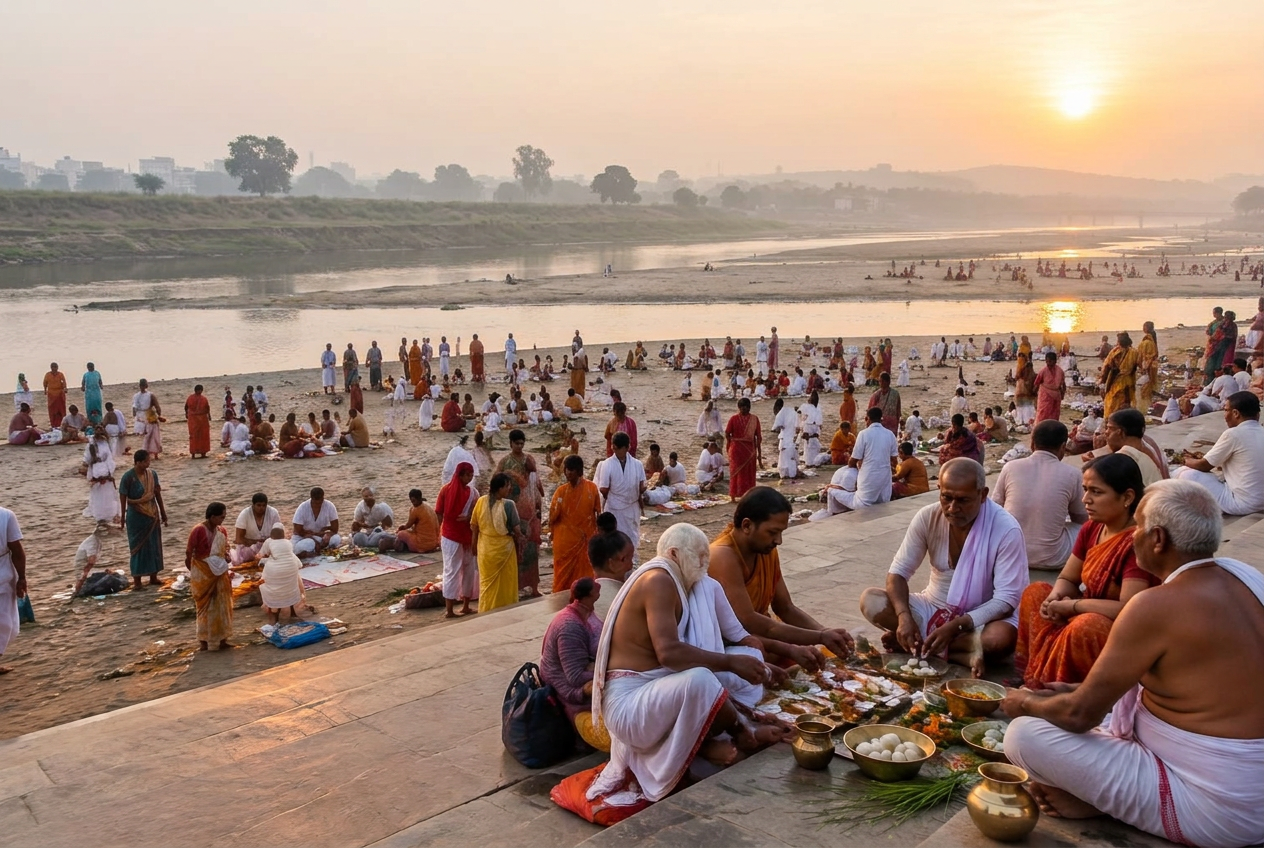
The grammar of Pitra Paksh is intimate: a name, a handful of grain, water passed from one pair of hands to another. A grandchild may know the person being invoked only through a photograph or a story. The rite gives that absent person a place at the centre of the day. This is an interpretation of its emotional force, not a scene witnessed by this publication.
Pitra Paksh — also written Pitru Paksha or Pitri Paksha — is the lunar fortnight dedicated to ancestors, generally falling in September or October. The precise civil-calendar dates shift each year. Families traditionally observe a shraddha on the lunar date associated with a relative's death; the closing new-moon day, Sarva Pitru Amavasya, is especially important for those whose death date is unknown or whose rites could not otherwise be performed. Bihar Tourism describes it as a sixteen-day period of remembrance marked by shraddha, tarpan and pind daan. [1]
In much of India this is a quieter season: new celebrations are often deferred, meals are simplified, names are spoken, food is offered. What looks from the outside like a suspension of festivity is, from within, an ethic of attention. The question is not whether the dead can hear us. It is whether the living can remember what made them possible.
The fortnight is not an annual trip to Gayaji for every family. Shraddha is observed in homes and at sacred places across India, and many visit Gayaji at other times too. What happens here during the mela is a concentration of practices that are larger than any single city. Nor is there one universal calendar of obligations: lineages, regions and officiating priests differ in what they prescribe. The recurring centre is the effort to give thanks to forebears rather than let inheritance become anonymous. [1, 5]
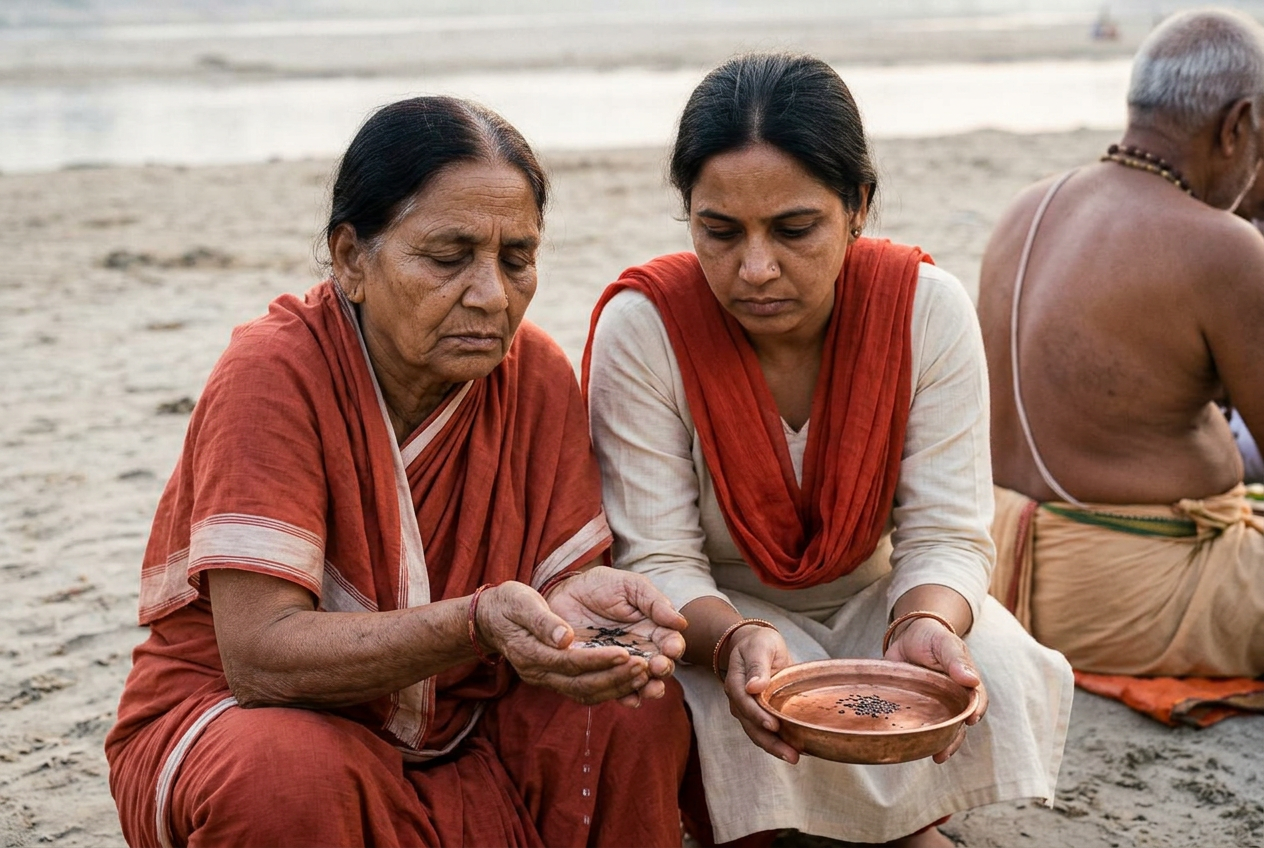
“Before we ask where Bihar is going, there is a moment each year to ask who brought us here.”
2. What the offerings mean.
Shraddha is the broad act of honouring the departed with faith and prescribed offerings. Tarpan is an offering of water, often with sesame, accompanied by the names of ancestors. Pind daan is the offering of pindas — usually balls of cooked rice or other grains, with ingredients varying by family and priestly tradition. The rites can also include feeding others and giving in memory of the deceased. Practices differ across communities; there is no single choreography that captures every Indian household. [1, 5]
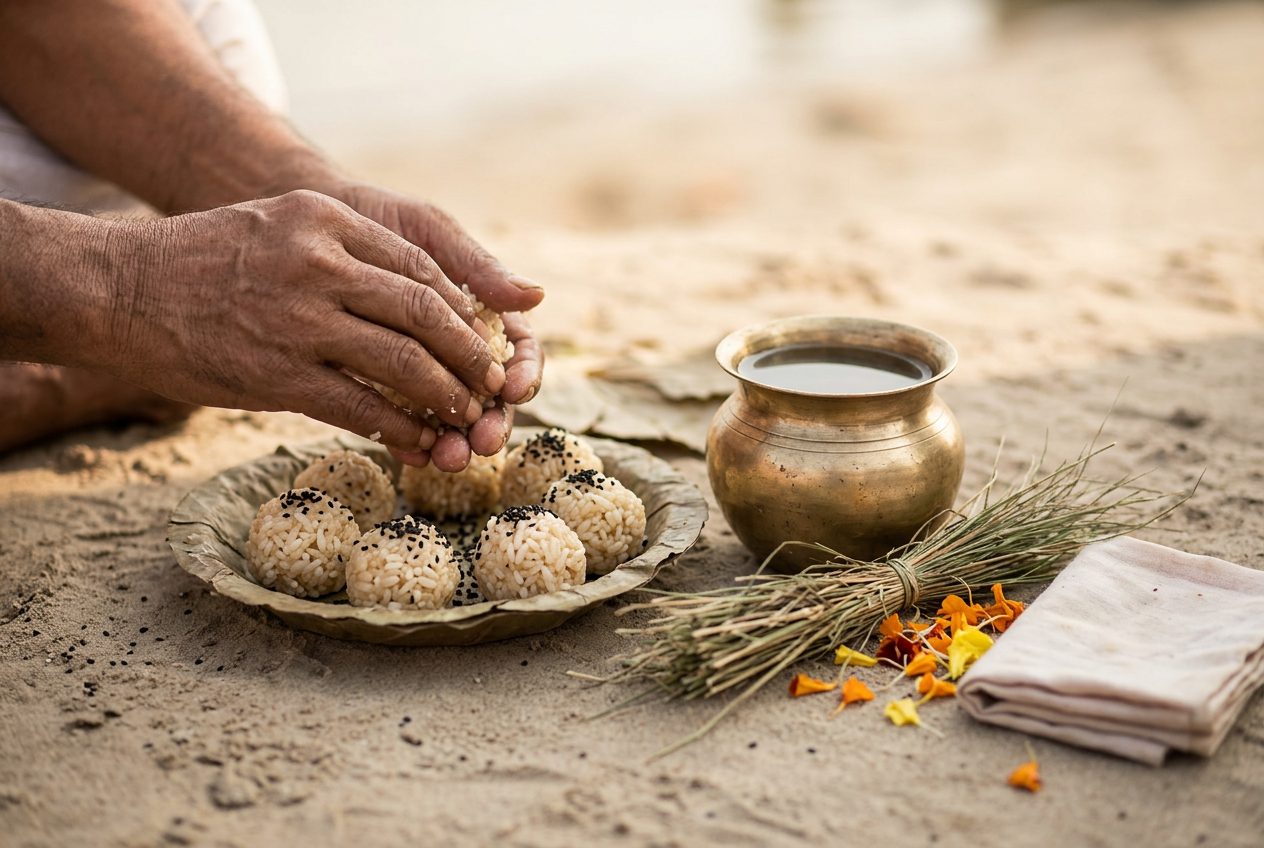
The ingredients deserve a closer look. A brass or copper lota carries water; dark sesame seeds punctuate its surface; a small bundle of kusha grass may lie beside leaf plates and rice or barley. The pindas are shaped by hand, not manufactured objects. At Akshayavat, Patna Press describes offerings made of “rice, barley, and sometimes khoya and kheer.” That report is a description of practice at one site, not a fixed recipe for every family. The modest scale of these materials is part of the rite's force: nourishment and water are offered where words alone feel insufficient. [17]
A pilgrim may bathe, state an intention or sankalpa, invoke the ancestor by name, make the food offering, and release water in tarpan. The order and duration can differ, especially between a short visit and an extended pilgrimage. A priest may guide the prayers, but the hand that shapes or releases the offering belongs to the relative who has come to remember. The purpose in religious understanding is to seek peace for the departed; no historian can prove a soul's journey, but a historian can observe that the obligation has drawn families here for centuries. [1, 14, 17]
The theological hope is peace and liberation for the departed; that is a matter of faith, not something a newspaper can measure. But another consequence is visible. The ritual makes kinship tangible. It asks a person to name a father, a grandmother, a lineage; to recognise that their own life arrived through the labour and love of others. In Indian thought, this is often spoken of as pitru rin, the debt owed to one's forebears. It is not a bill one settles once. It is a relationship one tends.
Nor must the meaning be reduced to private ancestry alone. A family comes to Gayaji carrying its own losses, but it sits beside hundreds of other families doing the same. The riverbank becomes a public commons of grief, gratitude and continuity. That is why the season has endured across languages and distances: a simple vocabulary — water, grain, a name — can hold what ordinary speech cannot.
3. Why Gayaji?
Ancestor rites take place throughout India. Gayaji is different because the whole landscape has become a map of them. The Phalgu, the Vishnupad Temple, Akshayavat, Pretshila, Ramshila and many other vedis (ritual stations) form a pilgrimage circuit rather than a single shrine. In the district's 2025 preparations, officials described 55 designated vedis, ponds and ghats across the wider itinerary, including Punpun; figures for such stations vary according to the circuit being counted. [4, 5]
At Vishnupad, pilgrims pray before a footprint revered as Vishnu's, set in rock. Bihar Tourism dates the present temple structure to 1787 and credits Queen Ahilyabai Holkar with its construction. The shrine stands close to the Phalgu, the river where many begin their offerings. The journey often ends at Akshayavat, the enduring banyan associated with the final prayers. [2, 5]
The sacred stories explain why this ground matters to believers. In one tradition, the ascetic asura Gayasura's body became so sanctifying that Vishnu's footprint fixed him to the earth; he asked that this place remain a path for the liberation of ancestors. Another story remembers Sita performing rites for Dasharatha beside the Phalgu and blessing the banyan that bore witness. These are religious narratives, not datable accounts of events. They give a landscape its symbolic depth: a river that can seem to disappear into sand, a footprint in stone, a tree that signifies remembrance without end. [2, 3]
At the Phalgu, myth and physical geography meet. In the story retold by India Water Portal, Sita makes an offering of sand for Dasharatha when Rama has gone to fetch provisions. Of the witnesses, only the banyan tells the truth; the tale says she blesses the tree and curses the river to flow out of sight. This is a local sacred explanation, not a hydrological finding. Its power lies in making the riverbank itself a participant in remembrance. [16, 17]
There is a second kind of evidence: the history of the pilgrimage's changing form. Historian Tomoka Mushiga writes in the Indian Historical Review that a modern “seventeen-day pilgrimage programme visiting forty-five holy spots” does not appear in that form in Sanskrit religious texts. Her research traces how later regulations and priestly manuals assembled a programme from older sacred material. This does not diminish the pilgrimage's antiquity; it makes the distinction between an old sacred landscape and a specific, evolving itinerary. The administrative count of 55 stations used in 2025, the scholarly account of a 45-stop programme, and the many sites named in sacred literature are not interchangeable totals. [4, 14]
The ancient city is not only a memory-site. The wider Gaya–Bodh Gaya landscape carries another great spiritual history, that of the Buddha's awakening. These are distinct traditions, not two names for the same rite. That two such histories are carried by this part of Bihar is a reminder of its unusually long place in the moral imagination of the subcontinent. [2]
4. A landscape, not one shrine.
A visit may begin at water and move through stone and tree. The Phalgu is a place to offer water and pindas; Vishnupad centres on the revered footprint; Pretshila, whose name invokes the departed spirit, and Ramshila are among the other hills and ritual stops. Akshayavat, the “undying” banyan, is associated with concluding offerings in many accounts of the circuit. These places do different symbolic work. To compress them into a single temple photograph would obscure the point: Gayaji is a relationship between a family, a sequence of offerings and a whole terrain. [2, 3, 5, 17]
In a 2025 report on the last day at Akshayavat, Patna Press describes Gayapal priests performing a farewell ceremony after the pindas are offered. Panda Samaj president Gajadhar Lal Katariyar told the publication that the ancestors “bestow blessings on their descendants” after the rite and feeding of Brahmins. This is his account of religious belief, not an independently verifiable outcome. But it illuminates why the last stop matters: leaving can itself be part of saying goodbye. [17]
Gayaji's sacred geography also poses a civic obligation. When families move between a riverbed, a shrine, a hill and a tree, accessible routes, legible information and clean water become part of what allows them to practise their faith with dignity. The infrastructure is not separate from the experience; it determines whether an older person can complete it safely.
5. The names in the registers.
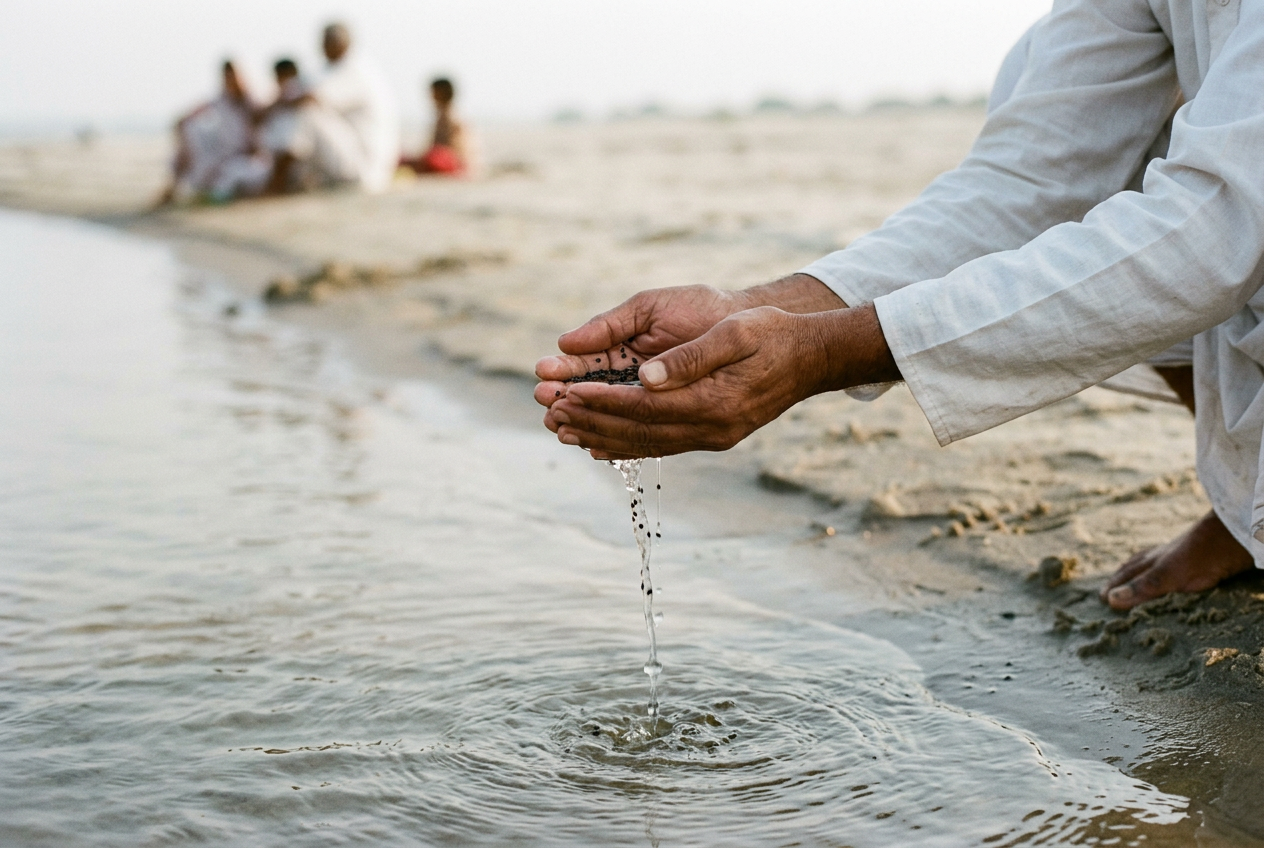
The Gayapal or Gayawal priests are more than officiants at a single ceremony. Some families maintain ancestral registers that connect visits across generations. In Millennium Post, reporter Raktim Dutta describes how entries can allow a returning family to locate a predecessor who once came to offer pinda. The report recounts Varun Gandhi finding an entry associated with Motilal Nehru. A written name beside a place and a generation can turn inherited family lore into a traceable encounter, though the completeness of any particular register depends on who visited and what was preserved. [15]
Gayawal priest Damodar Lal Mowar told the paper, “There can hardly be a failure in attempting to track one's ancestors”—provided a forebear made the journey to Gaya. His confidence is a practitioner's claim, not a guarantee that every visitor's genealogy survives. Records kept privately across priestly families are valuable precisely because they are fragile: vulnerable to water, wear, loss and the absence of public cataloguing. Digitising them without consent or extracting family histories for commercial use would introduce a new kind of harm. [15]
Here the sacred and the archival touch. The ritual asks the living to say a name; the register sometimes allows them to hear it answered by an older page. That is not proof of every story a family tells itself, but it is a rare continuity that deserves careful stewardship, with the custodians and families shaping any future preservation work.
6. The living pilgrimage.
The pilgrimage is also an immense logistical undertaking. In 2025 officials described free accommodation in government buildings, a tent city, e-rickshaws for elderly and disabled visitors, ring buses, health arrangements and crowd management around the narrow streets near Vishnupad. Many pilgrims come for a day; others follow a longer route over several days. The Gayapal priestly families, custodians of ritual knowledge and often of ancestral records, help visitors navigate a geography that is both sacred and practical. [4, 5]
Scale matters, but numbers need care. Times of India reported more than 23 lakh arrivals in 2024. For 2025, an electronic footfall count at Vishnupad was reported as 31.77 lakh, while a senior temple representative told the paper he believed actual attendance was lower than in 2024. Patna Press separately reported more than 2.85 lakh completed pind daan rituals as of September 20. These are not contradictory counts of the same thing: a temple passage, an estimated arrival and a completed ceremony have different denominators. None is a census of distinct pilgrims. [4, 10, 11, 17]
The mela is also work. Water sellers, food vendors, priests, flower sellers, transport workers and people who clean the ghats make an extraordinary concentration of visits possible. Patna Press quoted Central Bihar Chamber of Commerce vice-president Pramod Kumar Bhadani on food-related business of approximately ₹90–100 crore in 2025; the publication reported an estimated ₹600 crore overall economic impact. These are chamber and press estimates, not audited accounts. What they capture is that remembrance has a material economy whose benefits and costs are unevenly shared. [18]
As of early October 2026, this year's mela is in progress, so an interim footfall figure should not be treated as the final annual total. Reports of tent-city arrangements and sanitation reviews are evidence of preparations, not proof that every pilgrim received the promised service. Every year, the test is the same: can a city make a vulnerable visitor—sometimes old, grieving and far from home—feel looked after? [12, 13]
7. Famous names, ordinary grief.
Recent visitors have brought national attention to a rite that millions already knew. During the 2025 Pitra Paksh mela, President Droupadi Murmu performed pind daan and shraddha at Gayaji on September 20. Industrialist Mukesh Ambani came with his son Anant on September 19, offering pind daan and tarpan at Vishnupad and the Phalgu. Actor Puneet Issar was reported performing the rites during the same mela. Lalu Prasad Yadav visited with family that season, too. [6, 7, 8, 9]
Their presence matters to the city's visibility: Patna Press reported more than 520 VIP visitors in 2025, a category counted by organisers rather than a measure of the pilgrimage's meaning. A presidential visit is news because the President has come to do what an ordinary daughter, son or grandchild has done here for generations. The power of Gayaji is not that celebrated people arrive. It is that titles cease to matter before a name written on a priest's page. [18]
One distinction is worth keeping clear: not every famous person's pind daan at Gayaji happens during Pitra Paksh. The rite can be performed at other times of year. To describe every such visit as attendance at the annual mela is to blur the meaning of the event itself.
8. A city that receives the country.
For Gayaji, the mela is not a photo opportunity but an annual civic undertaking. Pilgrims need safe walking routes, clean ghats, transparent information, water, toilets, accessible transport and lodging they can trust. Families should be able to understand the ritual before they arrive and the costs before they pay. Priests, volunteers, shopkeepers and transport workers all shape the experience; none should be erased by the language of a tourism campaign.
There is room to build something enduring: multilingual guides to the vedis and their histories; respectful, consent-based preservation of family records; reliable support for elderly pilgrims; waste and river stewardship that lasts beyond the fortnight; better public reporting that distinguishes unique visitors from turnstile counts. These are proposals, not claims that the work is already done. They would make the country's trust in Gayaji easier for the city to carry.
Bihar is too often asked to prove its value through what it might become. In Gayaji, its value is already visible in what it has kept: a place where a child can hear an ancestor's name, where a family can turn absence into an act of care, and where, once a year, an entire country remembers that it did not begin with itself.
Editor's note
A desk-researched essay, not an on-site report. All four images are generated editorial illustrations, not photographs of real pilgrims or actual ceremonies. Ritual descriptions vary by family and tradition; quotations are short excerpts attributed to published sources. Historical analysis, sacred legend and reported attendance are distinguished throughout.
Sources & further reading
- [1] Bihar Tourism — Pitrapaksha
- [2] Bihar Tourism — Vishnupad Temple
- [3] Bihar Tourism — Pretshila
- [4] Times of India — Gaya's 55 ritual sites and 2024 attendance (1 September 2025)
- [5] Times of India — Pilgrimage route and Akshayavat (7 September 2025)
- [6] DD News — President Murmu's visit (20 September 2025)
- [7] PTI via Rediff — Mukesh and Anant Ambani (19 September 2025)
- [8] Times of India — Puneet Issar at the 2025 mela (8 September 2025)
- [9] Hindustan Times — Lalu Prasad Yadav and family (10 September 2025)
- [10] Times of India — 2025 mela turnout dispute (21 September 2025)
- [11] Organiser — electronic footfall count for 2025 (24 September 2025)
- [12] Times of India — early 2026 electronic count (29 September 2026)
- [13] Patna Press — 2026 mela preparations (25 September 2026)
- [14] Tomoka Mushiga, Indian Historical Review — Development of the Gayā pilgrimage programme (2020)
- [15] Raktim Dutta, Millennium Post — Pandas of Gaya, custodians of our ancestry (2020)
- [16] Chicu Lokgariwar, India Water Portal — Cursed by greed: the Falgu river (2015)
- [17] Patna Press — The final day at Akshayavat (2025)
- [18] Patna Press — 2025 mela turnout and local economy