The makhana cooperative reshaping a global category.
Bihar grows roughly 90% of the world's makhana. For most of the last century, almost none of that value stayed with the men and women who dive, six hours a day, into chest-deep ponds to bring it up. A farmer producer company in Darbhanga and a brand-new National Makhana Board are trying — finally — to change that arithmetic.
1. The pond crop nobody understood.
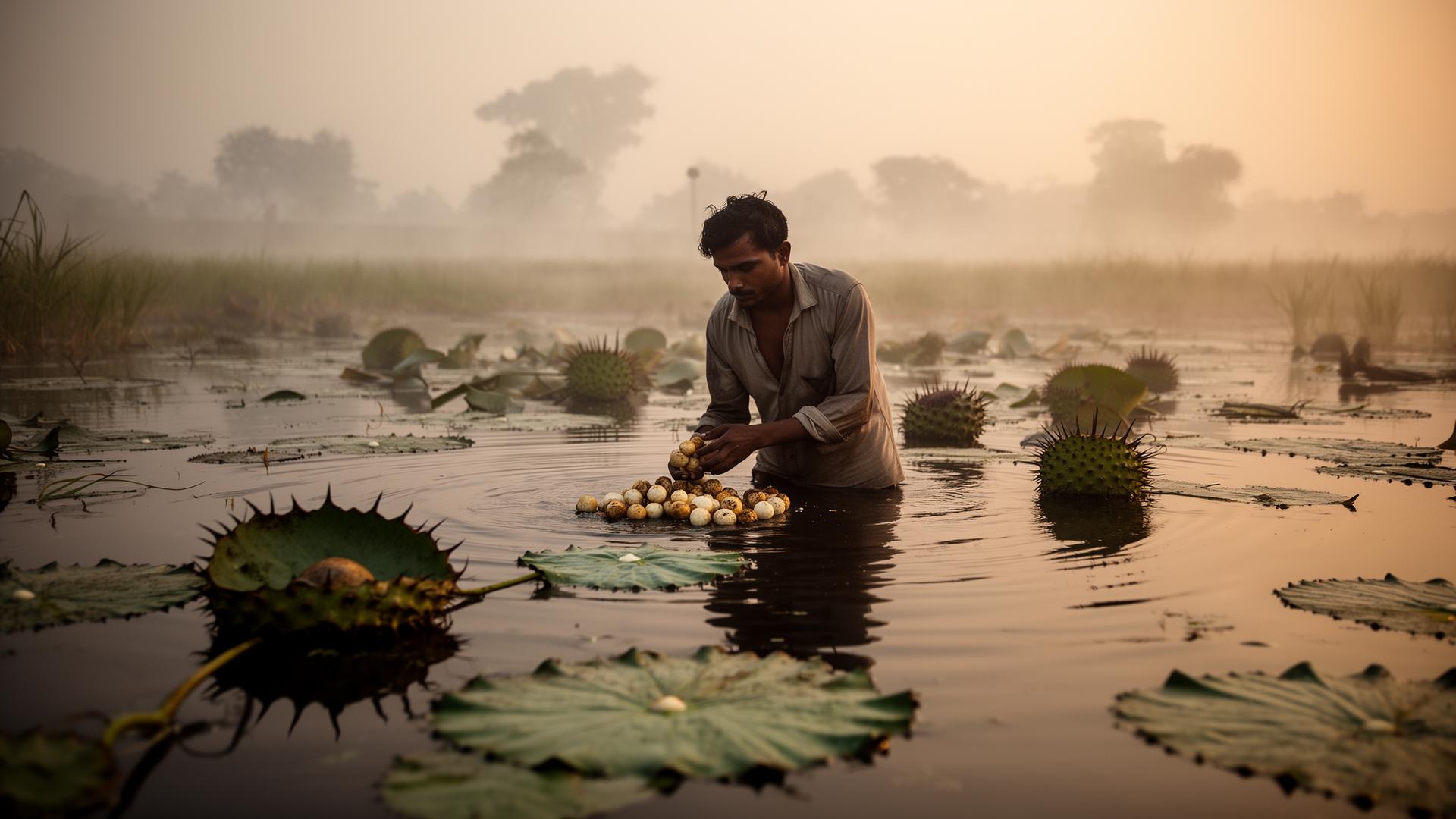
Makhana — botanically Euryale ferox, popularly fox nut or phool makhana — is not a tree crop, not a field crop, and not, strictly speaking, an agricultural product as the Indian state has historically defined it. It grows in stagnant, shallow water: temple tanks, ox-bow lakes, the chaur wetlands of north Bihar that the Kosi and Kamala leave behind every monsoon. Its leaves are circular, the size of a small table, and ridged underneath with spines. Its seeds sit at the bottom of the pond inside a thorn-armoured pod. There is no mechanised harvest. There has never been a mechanised harvest. Every seed that reaches a supermarket shelf in Brooklyn, Dubai or Tokyo has been picked, by hand, by a diver standing in opaque water up to their chest.
India produces roughly 90% of the world's makhana and Bihar produces roughly 90% of India's — the highest geographic concentration of any commercially traded "superfood" on earth, narrower than Mexican avocado or Peruvian quinoa. Nine districts in the Mithila and Seemanchal belt — Darbhanga, Madhubani, Purnia, Katihar, Saharsa, Supaul, Araria, Kishanganj and Sitamarhi — account for almost the entire crop. And yet, until the Geographical Indication tag for "Mithila Makhana" was granted in August 2022, the category had no protected origin, no national board, no minimum support price and no insurance product. It existed in the seams of the system.
2. The diver's day, in numbers.
Rajkumar Sahni is 41. He belongs to the Mallah community — the traditional fisherfolk of Mithila, who, by an unwritten division of labour that pre-dates any state, have always done the underwater work of the makhana crop. He leases a 1.2-acre pond near Kamtaul, about 22 km from Darbhanga town, for ₹38,000 a season. Between late October, when the seeds settle on the pond floor, and early February, he will be in the water for an average of five-and-a-half hours a day. He surfaces every 30–40 seconds with a fistful of seeds and a fresh breath.
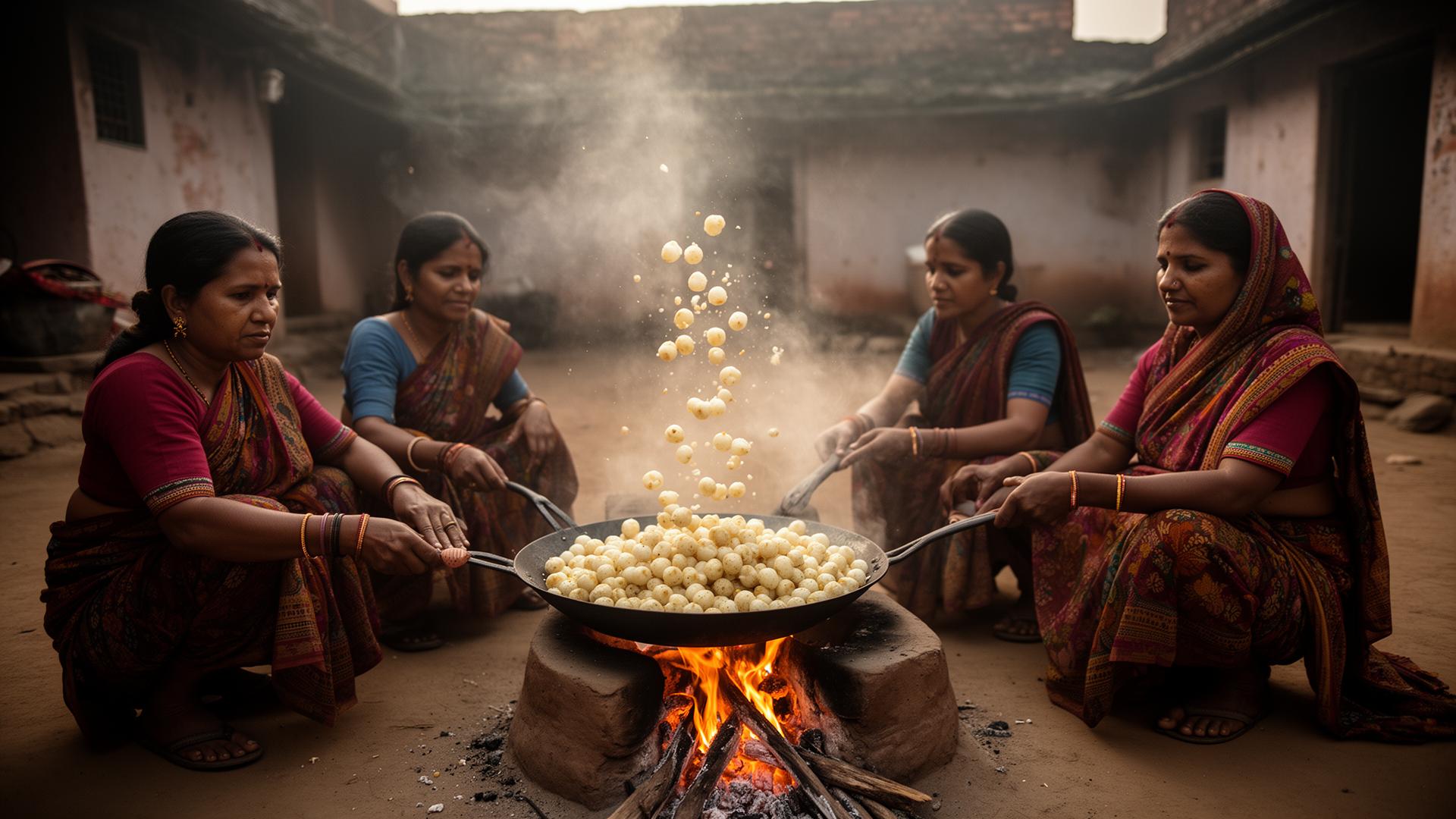
A 2024 ICAR–NRC for Makhana (Darbhanga) survey put the average diver's daily yield at 8–12 kg of guri (raw seed). Of that, roughly 35% will survive to become saleable popped makhana — the rest is moisture, shell and seed loss during the three-stage roasting and tempering process. At the farmgate rate of ₹220–260 per kg of raw seed that prevailed in the 2024–25 season, Rajkumar's gross daily income works out to between ₹1,760 and ₹3,120 — before pond lease, before fuel, before the cost of the women in his household who will sit, that night, in front of a smoking iron pan to roast and pop the seeds while they are still warm enough to crack open.
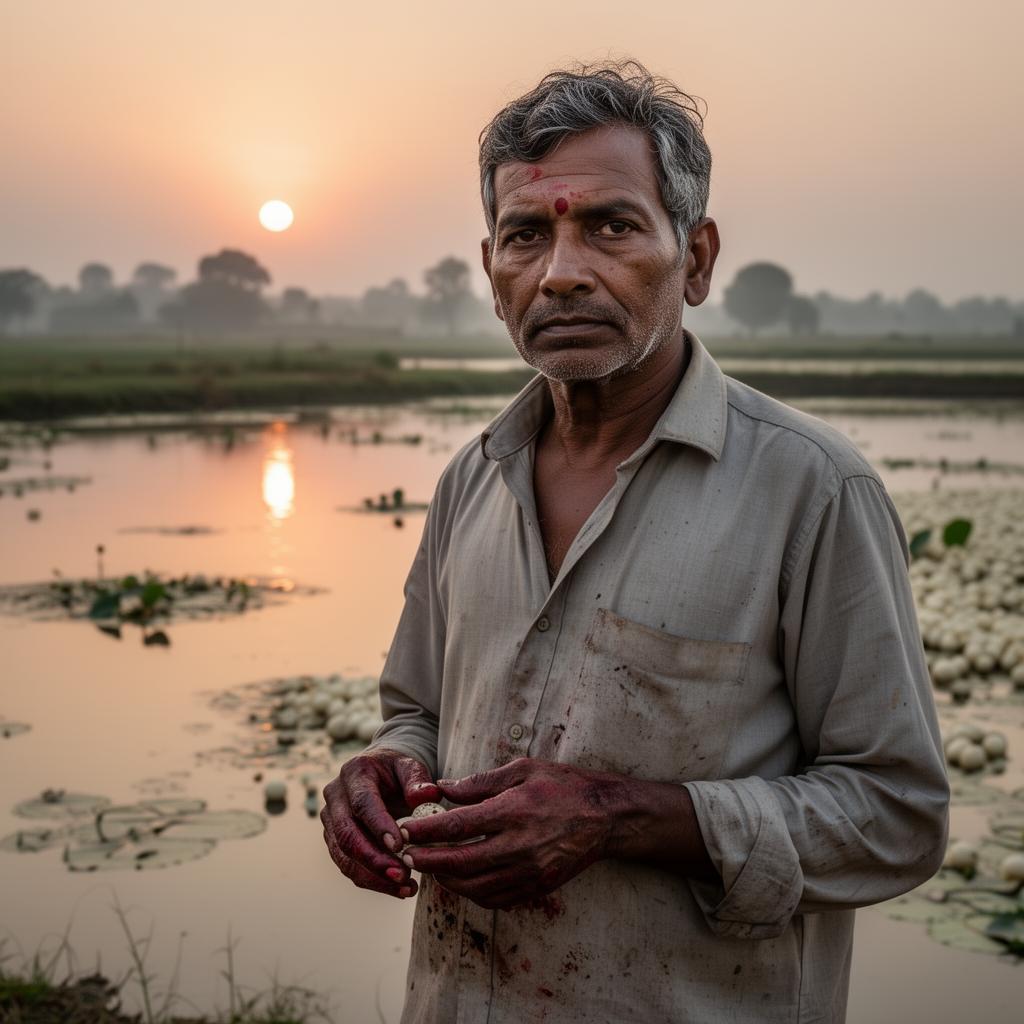
"By March my ears bleed. By April my back will not let me sit. By May I am loading trucks in Punjab. This is the crop. This has always been the crop."
The hazards are not folklore. A 2023 study published in the Indian Journal of Occupational and Environmental Medicine found that 71% of makhana divers in Darbhanga and Madhubani reported chronic skin infections, 58% reported hearing loss attributable to repeated pressure changes, and 44% reported musculoskeletal injuries serious enough to lose at least 30 working days a year. None were covered by ESIC. None were eligible for PMFBY crop insurance, because makhana, until very recently, was not on the notified crop list.
3. The cooperative that flipped the ledger.
Mithila Naturals Farmer Producer Company Limited was registered in February 2018, in Singhwara block of Darbhanga district, with 487 shareholder-farmers and ₹14.6 lakh of pooled equity. Its founding chairperson, Bibha Kumari, had spent the previous nine years running a Jeevika self-help group cluster in the same block. The proposition was simple, and, in the context of the makhana value chain, almost radical: the FPC would buy raw seed from member-farmers at a declared, public floor price; do the roasting–popping–grading in a shared facility instead of in twenty separate kitchens; pack under a single brand; and sell directly, by-passing the four-step Patna–Delhi–Dubai trader chain that had historically taken 60–70% of the final retail rupee.
The first season was a near disaster. The shared roasting unit, financed under NABARD's Producer Organisation Development Fund, was commissioned three weeks late. The first consignment to a Delhi wholesaler was rejected for excess moisture (above the FSSAI threshold of 8%). Bibha mortgaged her late husband's two-katha plot to pay the farmers anyway, on the principle — she said, the first time we sat in her office — that "if we did not pay them, we would never see them in this office again."
By the 2023–24 season, the FPC had 2,140 farmer-members across four districts, an annual procurement of 412 tonnes of raw seed (roughly 144 tonnes of finished product), and turnover of ₹11.8 crore. Its average pay-out to member-farmers, on a per-kg basis, was 38% higher than the prevailing village trader rate. It had become, almost without anyone noticing, the largest organised farmer-owned makhana entity in India.
Three things made the difference. First, aggregation: a single 144-tonne lot is a meaningful conversation with a private-label buyer in Mumbai; twenty 7-tonne lots from twenty households are not. Second, traceability: every member-farmer's pond was geo-tagged and the seed batches barcoded — the kind of compliance the EU's incoming CSDDD regulations will, by 2027, treat as mandatory for any agri-import. Third, and most underestimated, working capital: the FPC negotiated a ₹3-crore cash-credit line with SBI's Darbhanga commercial branch in 2022, which meant farmers were paid within 72 hours of delivery, against the 60–90 day cycle that defines almost every other makhana procurement relationship in Bihar.
4. The Makhana Board, and what it means.
On 1 February 2025, the Union Finance Minister announced, in the Union Budget speech, the constitution of a National Makhana Board, headquartered in Bihar. It was the first time in independent India's history that a single aquatic crop — restricted, in commercial terms, to roughly nine districts of one state — had received a dedicated statutory institution. The announcement was politically freighted (a Bihar election was due later that year), but the substantive content was real: a budget allocation of approximately ₹100 crore over five years; a mandate covering research, productivity, processing, branding and exports; and, crucially, the integration of makhana farmers into PM-Kisan, PMFBY crop insurance, and the Kisan Credit Card scheme on terms comparable to paddy and wheat.
The Board sits on top of three earlier-stage pieces of state plumbing that, taken together, finally constitute an industrial policy for the crop: the ICAR–National Research Centre for Makhana at Darbhanga (established 2002, upgraded 2018), which has released two high-yielding varieties — Swarna Vaidehi and Sabour Makhana-1 — that lift popping recovery from the traditional 30–35% to 45–48%; the GI tag of August 2022, which, like the Darjeeling tea or Banarasi silk GI before it, gives legal teeth to the word "Mithila"; and APEDA's 2024 inclusion of makhana on the schedule of notified agri-exports, which made TMA (Transport and Marketing Assistance) freight subsidies available for the first time.
Whether the Board becomes a real instrument or a letterhead will be visible by the 2027 harvest. The Coffee Board, the Coir Board and the Spices Board have, between them, produced almost every outcome on the institutional spectrum from genuinely transformative (Indian spice exports, $4.5 bn in FY24) to bureaucratically inert. The difference, every chairperson who ran any of those boards will tell you, was whether the Board controlled procurement and certification, or only marketing.
5. Why the world is suddenly listening.
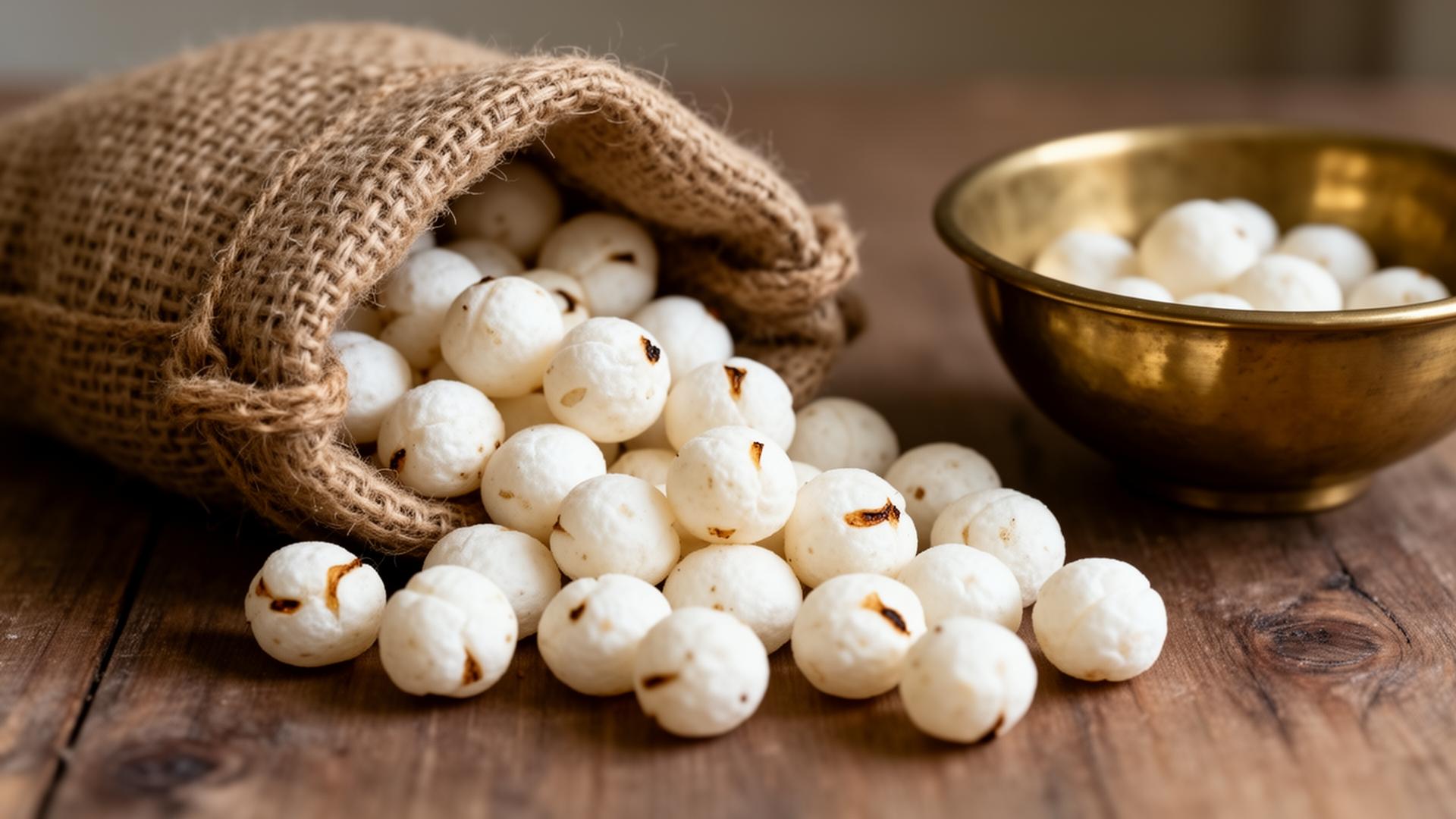
Makhana is, on almost every parameter that matters to a 2026 packaged-snack buyer, a category planner's dream. It is gluten-free, naturally vegan, low in sodium and saturated fat, and, per a 2023 review in The Pharma Innovation Journal, contains roughly 9.7 g of protein and 14.5 g of fibre per 100 g — comparable to almonds on protein and superior on fibre. It is low-glycaemic (GI ~ 35), which puts it on the shopping list of every Type-2 diabetic in urban India and, increasingly, in the ozempic-era United States. It contains gallic acid, chlorogenic acid and epicatechin — three polyphenols whose anti-inflammatory and antioxidant activity has been the subject of more than 60 peer-reviewed studies since 2018. And it puffs, when dry-roasted, to roughly 5x its raw volume — a snack physics that almost no other seed on earth replicates.
The market has noticed. India's makhana exports grew 27% year-on-year in FY 2024–25, to ₹255 crore ($30.5 million), against ₹201 crore the previous year. The top six buyer markets — USA, UAE, UK, Japan, Australia and Nepal — together absorbed 78% of shipments. Future Market Insights, in its 2025 fox-nuts forecast, estimates the global category at $75.3 million in 2024, growing at 9.45% CAGR, with a fair-case scenario of $190–210 million by 2031. Technavio puts the upside higher, projecting $115 million of incremental opportunity between 2024 and 2028, with North America contributing roughly 31% of net new demand. These are not large numbers, in absolute terms, against the global salty-snack market ($173 bn). They are extremely large numbers if you are a 487-farmer FPC in Singhwara block.
Three structural tailwinds matter more than the topline. The first is the global collapse in confidence in ultra-processed snacks: the EU's 2024 nutri-score enforcement and the FDA's 2025 sodium-reduction final rule are, between them, redrawing the salty-snack aisle of every western supermarket. The second is the rise of clean-label private brands — Whole Foods 365, Trader Joe's, Marks & Spencer Food — for whom makhana is exactly the kind of "single-ingredient, ethnic-origin, story-rich" SKU their merchandising teams are mandated to find. The third is the Indian-origin chef and influencer wave, which has done for makhana between 2022 and 2026 roughly what it did for ghee between 2016 and 2020: moved it from "ethnic" shelves to centre aisle.
6. The household-name decade.
Five years ago, makhana in urban India was a fasting food: a Navratri item, eaten by observant Hindus during the nine nights when grain is forbidden, and otherwise absent from the weekly grocery list. The change has been startlingly fast. Nielsen IQ India's 2025 packaged-snacks tracker reported that flavoured makhana grew 84% by value in modern trade between 2023 and 2025 — the fastest-growing snack sub-category in the country, ahead of baked chips, multigrain extruded snacks and protein bars. Three D2C brands — Farmley, Too Yumm! Foxnuts, and Mr. Makhana — together raised more than ₹400 crore in venture funding between 2021 and 2025. ITC's Yumitos, Marico's Saffola, and Tata Consumer's Soulfull have all launched makhana SKUs since 2023.
The category is migrating, in real time, out of the snack aisle and into adjacencies: makhana flour (for protein-fortified rotis), makhana kheer mixes, makhana-based ready-to-eat breakfast cereals, makhana protein bars. ICAR-NRC Darbhanga has, since 2024, been working with the Central Food Technological Research Institute in Mysuru on a shelf-stable popped-makhana extrusion suitable for ICDS mid-day-meal supply — a programme that, if it clears procurement, would route an estimated 18,000 tonnes a year of finished makhana into the Indian school-meal system. That single contract would double current organised production.
And then there is the soft-power dimension, which India's diplomatic corps has begun to deploy almost self-consciously. In March 2025, Prime Minister Modi presented a hamper of GI-tagged Mithila Makhana to the President of Mauritius in Port Louis. In September 2025, makhana was part of the official gift basket at the Quad foreign ministers' meeting in New York. None of this matters by itself. It matters because it is the kind of cumulative cultural placement that, over a decade, turns a regional crop into a global pantry staple — the way Japanese matcha, Peruvian quinoa and Mexican chia each made the journey before it.
7. The unfinished work.
None of this means the diver in Kamtaul has been made whole. The single most honest sentence anyone in the makhana value chain said to us, across four weeks of reporting, came from Dr. B. R. Jana of ICAR-NRC Darbhanga: "We have solved 60% of the science problem and 20% of the institutional problem. The market is moving faster than both." The risks are concrete. Pond leases, historically community property held by Mallah families, are being acquired by upstream consolidators — a 2025 study by the Bihar Land Reforms Commission documented a 23% rise in non-Mallah ownership of registered makhana ponds between 2019 and 2024. Climate variability is shortening the productive window: average pond-fill days dropped from 142 in 2010 to 119 in 2024. And the second invisible workforce — the women who roast and pop the seeds, often in unventilated kitchens at 280°C — remains entirely outside formal labour protection.
Bibha Kumari is clear about what the next five years have to look like. Mechanised, food-grade roasting at the village cluster level, so the women's labour moves out of the smoke and into a wage. A pond-level insurance product, underwritten through the new Makhana Board, that pays out on a 30-day rolling pond-water-level index. An export-grade processing and grading hub at Darbhanga, with a satellite cold chain to Kolkata port, so that the FPC can ship directly to a Whole Foods or a M&S buyer in container loads, not pallets. None of this is novel — every one of these interventions exists, in functional form, for cashew in Kollam, for saffron in Pampore, for cardamom in Idukki. None of it has existed, until now, for makhana in Mithila.
When the world finally puts a small packet of Mithila Makhana into its kitchen cupboard next to its almonds and its quinoa — and on the current evidence, it will, probably this decade — the question that will decide whether Bihar's resurgence has meant anything at all is whether the rupee per packet that flows back lands in a Singhwara block farmer-owned company, or in a Delhi-based distribution intermediary. The Board is built. The cooperative exists. The science is in place. The next harvest will start to tell us.
Reporting
Vatsala Vikram reported from Darbhanga, Madhubani and Purnia over four weeks in October–November 2026.
Data sources
APEDA MIC dashboards; ICRIER (2025); ICAR–NRC Makhana, Darbhanga; Future Market Insights; Technavio; FEED MAKHANA 360° Roundtable Report (2025).