The vegetable that became a sweet.
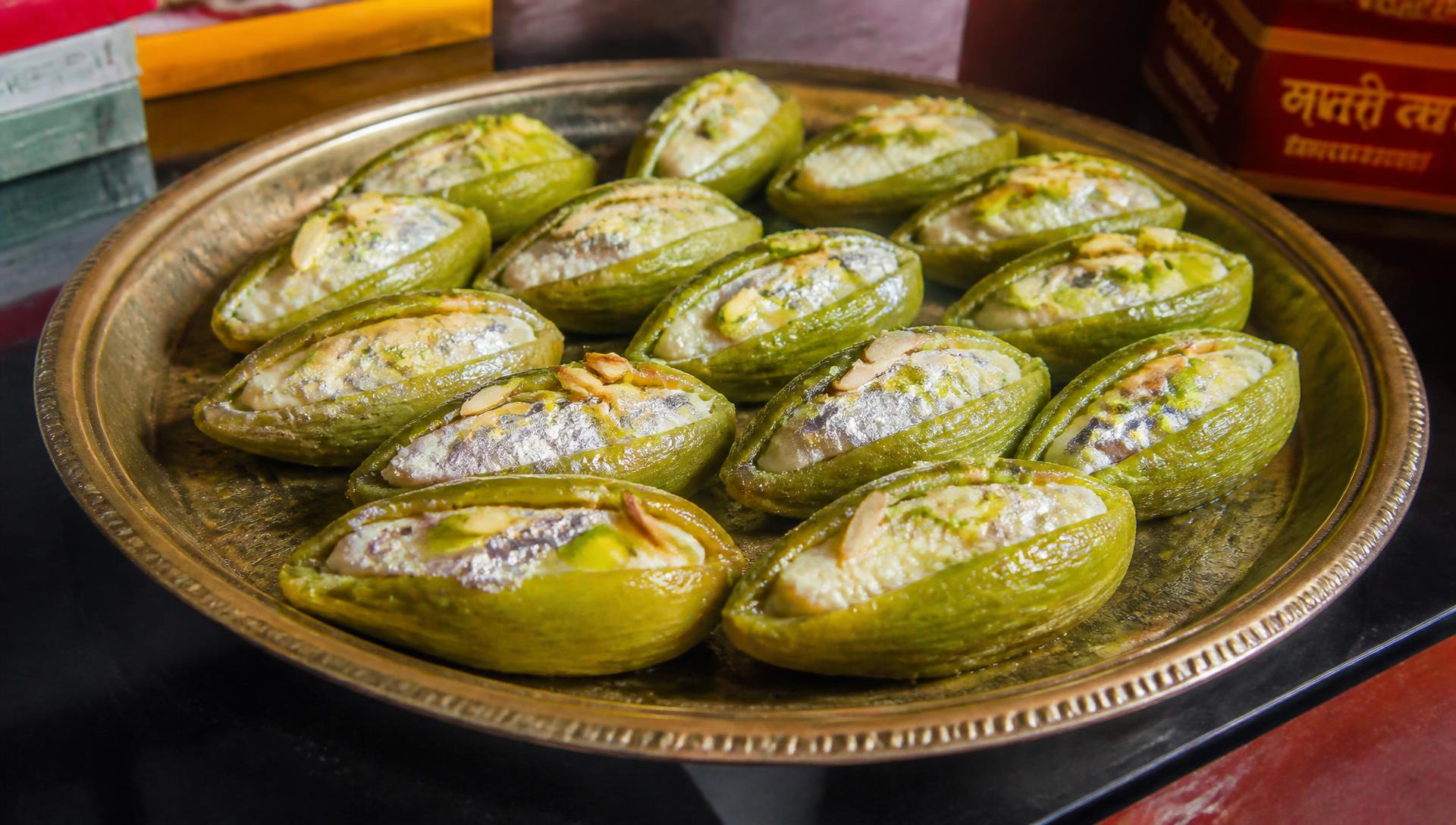
No other cuisine in India took a bitter, seedy, monsoon-season gourd, hollowed it out by hand, filled it with khoya and turned it into a wedding sweet. Bihar did. Parwal ki mithai is the most improbable dessert in the Gangetic plain — and, on the nutrition numbers, very nearly the most defensible.
1. A gourd with a pedigree.
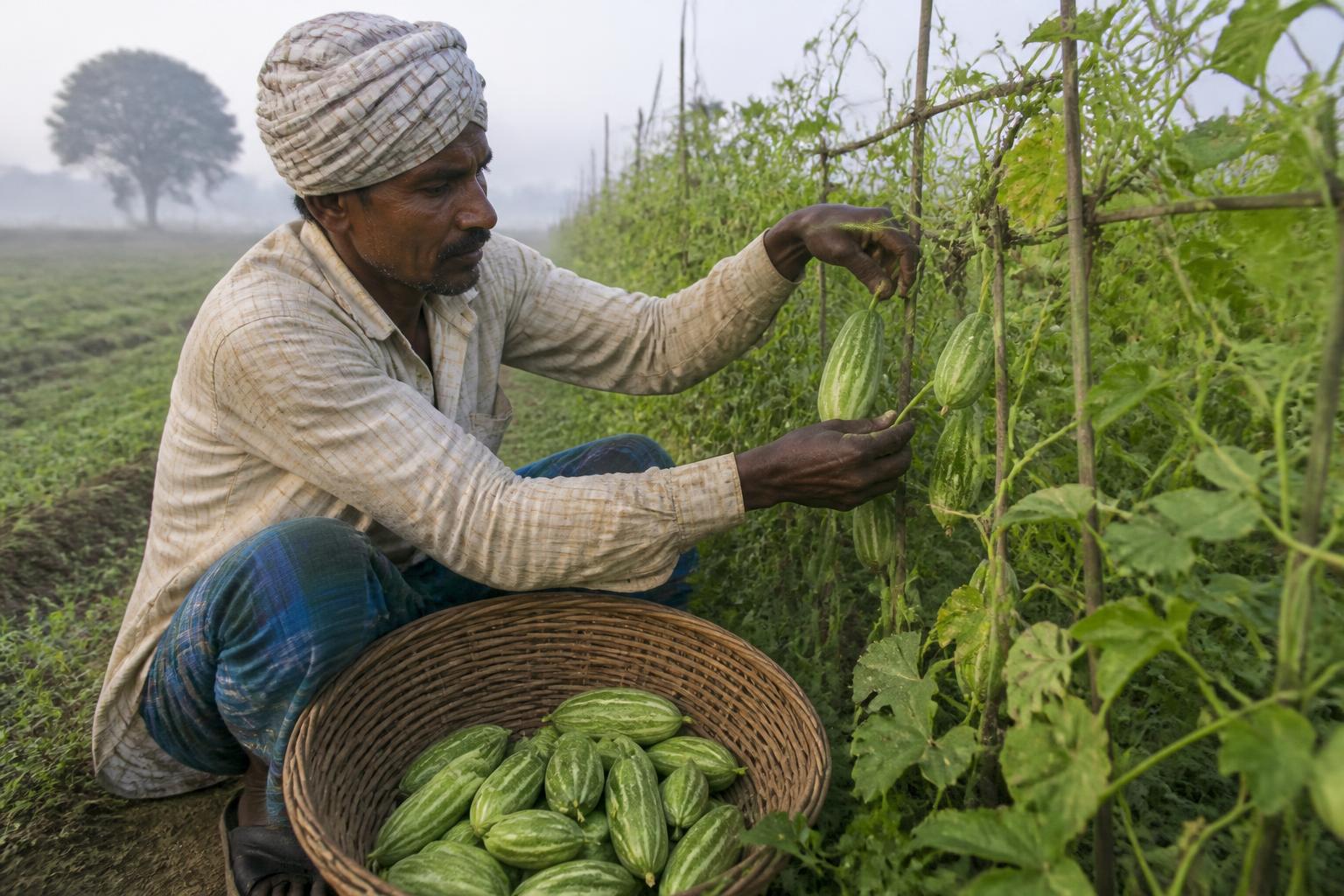
Begin with the vegetable, because the sweet makes no sense without it. Parwal — Trichosanthes dioica, the pointed gourd, potol in Bengali, patol in Maithili, patola in Sanskrit — is a dioecious perennial vine of the cucumber family that grows, almost exclusively in the world, on the alluvial plains of eastern India and Bangladesh. It is propagated not from seed but from vine cuttings, which is why a parwal field in Nalanda or Samastipur is in a real sense a clone of a field that existed a century earlier. Farmers plant it on bamboo trellises or in trailing beds in October–November, and pick from March through September. A well-managed hectare yields 8–12 tonnes.
Its pedigree in Indian medicine is older than almost any vegetable now sold in an Indian market. Patola appears in the Charaka Samhita and the Sushruta Samhita in the category of tikta shaka — bitter greens prescribed for fever, jaundice, disordered bile and poor appetite. Classical Ayurvedic texts treat it as pathya: the food a convalescent may eat when almost nothing else is permitted. Grandmothers in Bihar still repeat the compressed version of that pharmacology — bukhar mein parwal, parwal when you have a fever — without any idea that they are quoting a two-thousand-year-old text.
That is the first thing to understand about parwal ki mithai. It did not begin as a dessert. It began as medicine that someone decided to make delicious.
2. Where the sweet came from.
There is no founding document. What there is, instead, is a geography and a logic, and the two agree. The parwal sweet exists in exactly one contiguous cultural zone — Bihar, eastern Uttar Pradesh, Jharkhand and Bengal — and it exists under two names that betray two parallel lineages: parwal ki mithai in the Hindi-Maithili belt, and potoler misti in Bengal. The Bengali version leans on the nineteenth-century Kolkata sandesh tradition and is often filled with chhena. The Bihari version is older in feel and khoya-based: mawa reduced over hours, sweetened with cardamom, sometimes with grated coconut, sometimes with a wisp of saffron.
The logic is seasonal arithmetic that anyone who has run a kitchen in the Gangetic plain will recognise. Parwal peaks in the hot, wet months — precisely the months when milk sours in hours and when the wedding and vrat calendar demands sweets anyway. Ripe mangoes are gone, sugarcane is months away, and the one thing the field is producing in unembarrassed abundance is a gourd nobody is excited about. So the halwai does what halwais have done for centuries with an inconvenient glut: he candies it. Sugar syrup is the oldest preservative in the subcontinent, and the parwal's thick, fibrous wall takes a syrup soak better than almost any other vegetable — it firms rather than collapses.
Older halwai families in Patna City and Biharsharif date the shop version of the sweet to the late nineteenth and early twentieth century, when khoya supply chains from the cattle belts of Vaishali and Begusarai first made mawa a daily commodity rather than a festival splurge. Before that, the household version — parwal boiled in gur syrup, stuffed with grated coconut and khoya on a festival morning — was almost certainly the parent form. It survives, still, in villages in Muzaffarpur and Saran, where the sweet is made at home for Teej, for Bhaiya Dooj, for a daughter's wedding, and is not bought at all.
It is also, quietly, a sweet with an eating-order etiquette. In much of Bihar it is served last, after the kheer and the laddoo — because the faint vegetal bitterness behind the sugar is understood to be a digestive, a full stop rather than another sentence. That is not folklore added later. That is the Charaka classification surviving inside a dessert.
"We do not put the sweetness into the parwal. We take the bitterness out, slowly, and then let the parwal decide how much sugar it will accept."
3. Eleven steps, four hours.
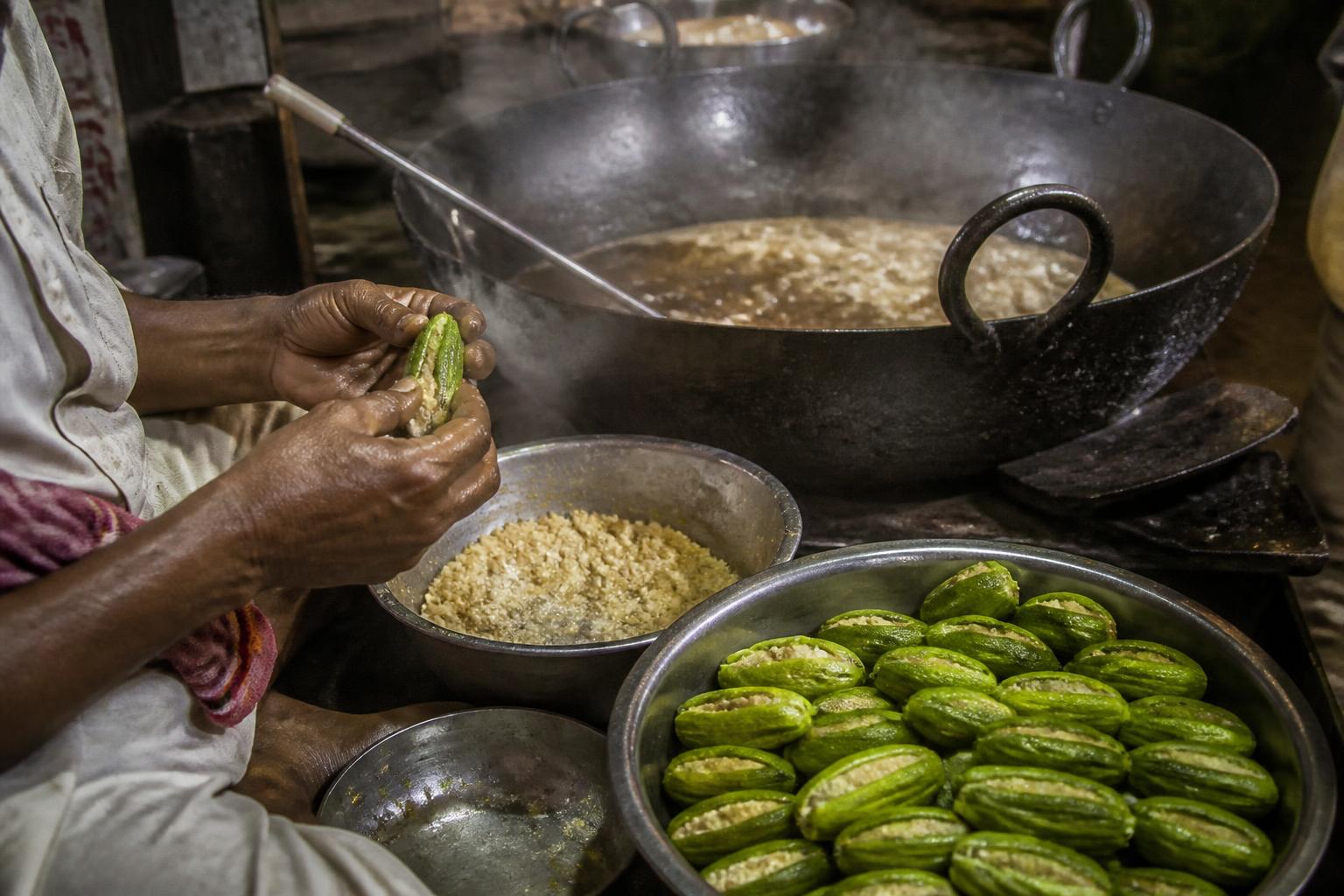
The craft is unforgiving, and it is the reason this sweet has never industrialised. The sequence, as practised in a working Patna shop: select small, tender, straight fruit; lightly scrape — never peel — the ridged skin, so the shell keeps its structure and its colour; slit lengthwise on one side only; scoop the seed core out with a thin blade or the back of a spoon without piercing the opposite wall; blanch in water with a pinch of alum or a spoon of lime water to set the flesh; drain; simmer in a one-string sugar syrup until the shell turns translucent and stops absorbing; cool overnight so the syrup finishes migrating inward; prepare the filling — khoya cooked down with sugar, green cardamom, sometimes chhena for lightness, sometimes coconut, sometimes chopped almond; pipe or press the filling in; finish with silver vark, pistachio slivers and, in the better shops, a single strand of saffron.
Every step has a failure mode. Peel too deep and the shell disintegrates in syrup. Blanch too long and it turns khaki. Use too heavy a syrup and the sugar case-hardens the outer wall while the centre stays raw and bitter. Fill while the khoya is warm and the fat separates and weeps into the shell overnight. The scooping alone — the step that decides yield — cannot be mechanised at small scale, because a pointed gourd is not a standard object: length varies from 4 cm to 12 cm on the same vine. A skilled worker cleans roughly 200 to 250 shells an hour. Rejection runs at 15–20 per cent.
This is why parwal mithai is priced where it is — typically ₹700–₹1,100 a kilo in Patna in 2026, two to three times a plain khoya barfi — and why it is made in batches of dozens rather than trays of hundreds. It is one of the last labour-dense sweets in a market that has otherwise standardised itself into extruded uniformity.
4. What the science says.
Parwal is one of the better-studied minor vegetables in South Asian pharmacology, and the literature is unusually consistent with the classical claims.
Blood sugar. A controlled human study by the Bangladesh Institute of Research and Rehabilitation in Diabetes, Endocrine and Metabolic Disorders (BIRDEM), published in the Asian Journal of Clinical Nutrition (2011), fed pointed gourd alongside a standard carbohydrate load to people with Type 2 diabetes and recorded significantly blunted post-meal glucose and insulin responses versus control. Animal work has been going the same way for two decades: a review in the Journal of Ayurveda and Integrative Medicine(Sharmila Banu et al., 2012) collated antihyperglycaemic and antihyperlipidaemic effects of T. dioica extracts in diabetic models. A 2021 in-vitro study in the Journal of Pharmacognosy and Phytochemistry found the methanolic extract inhibited alpha-amylase and alpha-glucosidase — the two starch-digesting enzymes that pharmaceutical drugs such as acarbose target — which is a plausible mechanism for the human observations.
Lipids and the liver. Multiple rodent studies report reductions in total cholesterol, LDL and triglycerides with aqueous and methanolic fruit extracts, alongside hepatoprotective activity — consistent with the traditional use of patola in jaundice, a disease Bihar knows too well. A broad review in Food Science and Human Wellness (2018) catalogues antioxidant, antimicrobial, anti-inflammatory and wound-healing activity attributed to the plant's flavonoids, phenolics, cucurbitacins and tannins.
The base food. Independently of any pharmacology, raw parwal is a genuinely good vegetable by the plain numbers: roughly 20 kilocalories per 100 g, about 92 per cent water, negligible fat, around 2 g of dietary fibre, with vitamin C, vitamin A precursors, potassium, magnesium and copper. It is the sort of profile a dietitian would design if asked to invent a vehicle for a dessert.
5. The honest nutrition ledger.
Now the part most food writing about this sweet skips. Parwal ki mithai is not health food. It is a sweet, and the syrup and the khoya do what syrup and khoya do: a single medium piece lands somewhere in the range of 120–180 kilocalories depending on the shop's syrup strength and fat content, most of it from added sugar and milk fat. No quantity of cucurbitacin research changes that arithmetic.
What is fair to claim is relative, and the relative case is strong. Compared with the Indian mithai canon it sits beside — gulab jamun, balushahi, imarti, laddoo — parwal mithai is the only one whose structural body is a vegetable rather than refined flour or fried dough. That single substitution buys three things: fibre and micronutrients the others do not have; a lower total sugar load per gram, because the shell occupies volume that would otherwise be maida and syrup; and no deep-frying at any stage. The khoya contributes protein and calcium that a besan laddoo cannot match at the same weight.
There is a real modern opportunity in that gap. Three formulation changes, all demonstrated in Indian food-technology literature and all cheap, would move the sweet meaningfully: replace part of the sucrose syrup with jaggery or date-palm gur, which Bihar already produces; use low-fat khoya or a chhena–khoya blend to cut saturated fat; and shorten the syrup soak, accepting a shorter shelf life in exchange for a lower sugar uptake. A "diabetic-friendly" parwal mithai has been attempted by individual halwais in Patna and Ranchi for at least a decade. Nobody has yet done it with a lab, a label and a number on the box. That is a product waiting for a founder.
6. The three-day problem.
Ask any Bihari in Bengaluru, Dubai or New Jersey what they cannot get, and parwal mithai is on the list within three answers. Ask a Patna halwai why he does not ship it, and the answer is a number: two to three days at ambient temperature before the khoya turns and the shell weeps. A high-moisture milk solid inside a high-moisture vegetable, in a humid climate, is a microbiologist's worst-case sandwich.
This is a solved problem, and it was solved in Bihar. A study by Brij Bhushan Mishra and colleagues, published in Current Research in Nutrition and Food Science(2019) and carried out in the food-technology stream at Bihar Agricultural University, Sabour, tested modified-atmosphere packaging of parwal sweet against storage temperature, tracking physico-chemical, microbial and sensory characteristics. The finding was straightforward: an altered gas mix inside the pack, combined with refrigeration, held microbial counts and sensory scores within acceptable limits for roughly a month — an order-of-magnitude extension over the three-day ambient baseline.
Seven years later, essentially no commercial parwal mithai in Bihar is sold in modified-atmosphere packaging. The research sits in a journal; the sweet sits in a cardboard box tied with string. The gap between those two facts is, in miniature, the entire problem of Bihar's food economy: the state does the science and someone else, eventually, does the business. Bengal's rasgulla travelled the world in a tin. Mysore pak travels in vacuum-sealed film. Kaju katli has a 45-day printed shelf life. Parwal mithai, the most distinctive sweet the Gangetic plain has produced, does not travel past Mokama.
7. What Bihar should do with it.
A short, unromantic agenda, in the order it would actually work.
One: pack it properly. One serious producer adopting the Sabour MAP protocol — food-grade tray, gas flush, cold chain to a metro airport — converts a three-day local sweet into a thirty-day shippable product. That is not innovation; it is procurement of equipment that already exists.
Two: put a number on the box. Lab-tested calories, sugar, protein and fibre per piece, printed. The health story for this sweet is real but only survives contact with an honest label; a vague claim will be demolished on the internet within a week.
Three: buy the reject grade. The small, crooked, thin parwal the vegetable mandi discounts is exactly what the mithai wants. A sweet enterprise that contracts a Nalanda or Samastipur farmer group for mithai-grade fruit at a guaranteed price creates farm income out of what is currently a market loss.
Four: register the name. Mithila Makhana has a GI tag; Bhagalpuri silk has a GI tag; Katarni rice has a GI tag. There is a defensible case for a geographical indication or at minimum a state-certified "Bihar Parwal Mithai" mark, with a specification — shell dimensions, khoya solids, no artificial colour — that protects the craft version against a cheaper imitation the moment the category gets attention.
Five: teach it. The scooping skill lives in perhaps a few thousand pairs of hands, most of them over fifty. A short certified module at a Patna or Bhagalpur food-craft institute, with a stipend, would cost less than a single road-side hoarding campaign and would keep the technique alive for another generation.
There is something fitting about all this. Bihar's most characteristic sweet is not an extravagance. It is a bitter vegetable, grown on a floodplain, prescribed to the feverish two thousand years ago, hollowed out by hand and made sweet enough to serve at a wedding. It is thrift turned into ceremony — which is, if you have spent any time in this state, the single most Bihari sentence one can write about a dessert.
Reporting
Reported from halwai kitchens in Patna City and Biharsharif and parwal fields in Nalanda and Samastipur.
Sources
Mishra et al., Current Research in Nutrition and Food Science (2019); BIRDEM / Asian Journal of Clinical Nutrition (2011); Sharmila Banu et al., J. Ayurveda Integr. Med. (2012); Food Science and Human Wellness(2018); J. Pharmacognosy & Phytochemistry (2021); Charaka and Sushruta Samhitas.